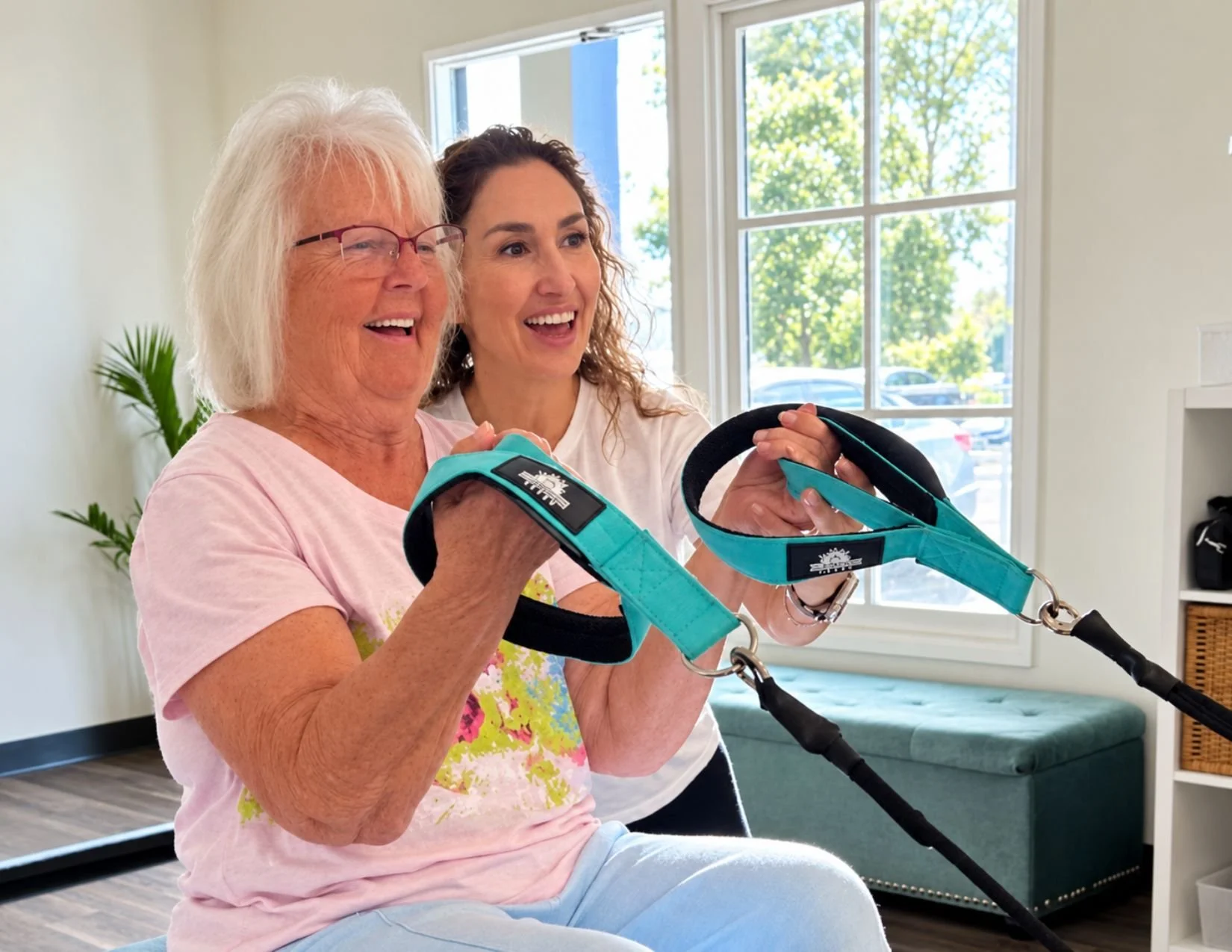
Someone you trust told you Pilates would help. Maybe your doctor, maybe a friend who swears by it. So you looked, and you found two very different things: women on mats on a gym floor, and women on a long sliding machine with springs and straps. Now you're not sure which one is meant for you.
Here's the difference, and why it matters more after 40 than it did at 25.
The Short Answer: Same Method, Different Support
Mat and Reformer Pilates come from the same method. The difference is what carries the load, and on the Reformer that load can be adjusted as you get stronger.
Mat Pilates is done on the floor, with nothing but you and a mat. On a Reformer, you lie, sit or kneel on a padded carriage that slides along a frame, and springs underneath it set the resistance.
The springs were part of the method from the start. Joseph Pilates designed his spring-based equipment in the early twentieth century, and some of his earliest work was with people who couldn't get out of bed. He didn't add springs to make the exercises harder. He added them so a body that wasn't ready to do the work alone could still do it.
It Starts With Your Breath
Whichever you choose, the method underneath is the same, and it's built from the inside out: your breath first, then your deep core, then everything else. That order isn't a warm-up you get through on the way to the real exercise. It is the exercise.
It's also why Pilates reaches parts of you that other exercise tends to miss. It works your pelvic floor as part of the system it belongs to, together with your breath and your deep core, instead of asking one muscle to squeeze on its own.
What Mat Pilates Asks of Your Body
Mat work needs no equipment, so it's something you can keep up at home or when you're traveling. If you'd like a feel for it, here are [five Pilates exercises you can try at home for your pelvic floor] (link: /blog/5-pilates-exercises-that-help-your-pelvic-floor).
But the floor asks more of a beginner than it looks. On a mat, your own body weight is the resistance. Many of the classic mat exercises ask you to lift your head, arms or legs against gravity, with nothing to help you.
Mat work also means getting down to the floor and back up again, which for some women is a hurdle on its own. A Reformer sits above the floor.
What the Reformer Changes
Springs That Can Help You or Challenge You
On the Reformer, springs set the resistance. Depending on the exercise and how they are set, they can help you through a movement or ask more of your muscles, so the same exercise can be made easier or harder.
That's why spring settings aren't a simple dial from easy to hard. In some exercises, more spring adds resistance. In others, it adds support. And a lighter spring can make the carriage harder to control, because your own muscles have to steady it instead.
Support Where You Need It
The carriage, footbar and straps give your body something to push against and something to hold, which can make it easier to feel where a movement should come from.
You Start Above the Floor
Getting onto a Reformer is closer to sitting down on a low bench than lowering yourself to the ground, and getting off it is the same.
Mat and Reformer at a Glance
| Question | Mat | Reformer |
|---|---|---|
| What carries the load | Your own body weight | Springs, set lighter or heavier |
| Where you work | On the floor | On a padded carriage above the floor |
| What supports you | The floor | A footbar, straps and a carriage to push against and hold |
| How it progresses | Hard to adjust finely | Adjusted a little at a time |
| Where it fits after 40 | A supplement at home or when you travel | The better place to begin, with someone watching how you move |
Is the Reformer Harder for a Beginner?
It looks harder. Straps, springs, a carriage that moves under you. But the parts that make it look complicated are the parts that let the work be set for where you are today.
What usually makes Pilates feel too hard isn't the equipment. It's work set for whoever happens to be in the room, with nobody adjusting it for you.
Why the Difference Matters More After 40
After 40, the body you bring to Pilates has been changing on its own schedule, and the reason you were told to try it is usually specific. That's where being able to set the load matters most.
Your Deep Core
These aren't the muscles that show. They're the ones underneath that hold your spine and pelvis steady when you lift, twist, or stand up from a chair. On springs, they can be worked at a load your body is ready for today, and asked for a little more next month.
Your Bones
Bone responds to being loaded, and springs are load. That's part of why therapeutic Pilates supports bone density.
Your Pelvic Floor
If leaking or pressure is part of your story, it's something a specialist can watch for and adjust around during the session, instead of something you manage on your own on a mat at home.
The Aches That Arrived Without Warning
Most of them aren't injuries. They're what happens when you've moved the same way for thirty years in a body that has changed. Equipment that can be adjusted gives you a way to move differently without starting at a level that's too much.
So Which Should You Start With?
For a woman starting after 40, the Reformer, with someone watching how you move, is the better place to begin. Because the springs can be adjusted a little at a time, the work can start where you are today and keep progressing as you get stronger. A mat can't be adjusted that finely, which is why it works best as a supplement to equipment work, not a replacement for it.
What That Looks Like in Practice
One of our clients came to us in her sixties after six months of mat exercises from YouTube videos at home. She was consistent, but she'd stalled: the exercises felt too hard to do well, and she wasn't sure she was doing them correctly.
Over the span of six weeks on the Reformer, we lightened the springs for the movements she'd been forcing and added load where she was ready for more. Then she went to Europe, and she told us she was amazed how steady she felt walking on the uneven brick streets, and how much stronger she felt carrying her luggage.
She still does a few mat exercises at home on the days she isn't in the studio. Now they're the supplement, not the whole plan.
That's how therapeutic Pilates in Encinitas works at Revive: every session on equipment, with a specialist watching how you move. It's also why Pilates is so often part of the plan for back pain.
If pain, leaking, or a recent surgery is part of why you were told to try Pilates, tell us when you reach out. We'll talk it through with you and recommend whether to start with a Pilates Intro Session or a Discovery Visit.
Either way, the point isn't the Reformer. It's gardening, reaching into the top cupboard while you cook, and getting down on the floor with your grandkids and back up again, without wondering if you'll pay for it later.
How We Use Equipment at Revive
Alongside the Reformer, we use the Cadillac, the chair, the barrel and the springboard, and we progress clients onto them when the time is right. We don't teach mat classes.
Bring grip socks; they're required, and we sell them at the front desk.
What Your First Session Looks Like
Your Pilates Intro Session is 60 minutes, one-on-one with a women's health specialist. It starts with the Revive Movement Screen™: how you breathe, how you load, and how your core and pelvic floor respond under pressure.
Then you get on the Reformer. Most first sessions begin with footwork: you lie on your back on the carriage with your feet on the footbar, press the carriage away, and control it back. It looks simple. It's where we see how your hips, knees and feet line up, and what your breathing does under a little load, before anything harder is added.
You leave knowing which program fits your body, and why: private sessions, small classes of no more than six, or both.
Questions You Might Have
Can I Do Both Mat and Reformer Pilates?
Yes. Mat work makes a good supplement at home or when you travel, alongside your sessions on equipment. Ask us which mat movements fit what you're doing in the studio, so the two work together.
Do I Need to Know How the Equipment Works Before I Come?
No. You don't need to know what a Reformer is, or how the springs and straps work. A specialist sets everything up, explains each movement, and adjusts it as you go.
(The close follows straight on — no heading, four paragraphs, left-aligned.)
If you've been told Pilates would help and aren't sure where to begin, our guide You Were Told Pilates Would Help. Read This Before You Start covers what to look for so it isn't too hard and you don't get hurt.
If you live in or near North County San Diego, start with a Pilates Intro Session, where we take you through the Revive Movement Screen™ and show you how Pilates can be adapted for your body.
If pain, leaking, or a recent surgery is what's holding you back, start with a Discovery Visit instead: one 60-minute session with a women's health specialist at our Encinitas studio, and you walk out with a plan built for the body you have now.
No referral needed. No pressure — just answers and a plan.