

Hysterectomy Recovery Physical Therapy · Encinitas, CA
Your Surgeon Cleared You. You Still Don’t Feel Like Yourself. That Ends Here.
Hysterectomy recovery physical therapy for women over 40 in Encinitas, CA.
Specialized care that rebuilds the core and pelvic floor strength the six-week clearance was never designed to restore — whether your surgery was last month or fifteen years ago.
Start With a Discovery Visit →
No referral needed. No pressure — just answers and a plan.
Dr. Dawn Andalon, DPT · Creator of the Pelvic & Core Reset™ Method · Practicing in North County since 2016
Six weeks, and then nothing. Dr. Dawn on the appointment nobody schedules.01
Root-Cause Care, Not
Symptom Management
02
Every Specialist Personally
Trained by Dr. Dawn in the
Pelvic & Core Reset™ Method
03
Integrated PT & Therapeutic
Pilates — The Only Practice of
Its Kind in North County
Your Surgeon’s Job Was to Perform the Surgery. Nobody’s Job Was to Help You Actually Recover.
Until Now.
You had the surgery and it worked. Six weeks later your surgeon confirmed everything had healed, told you to listen to your body and resume activities as tolerated, and that was the end of medical guidance.
So you went home and figured it out alone. You tried to return to what you used to do and something was off — pressure, heaviness, weakness, or pain you did not have before. So you did less. And you started wondering whether this was just how things would feel now.
You’re here because you know something is missing from the standard recovery protocol — and you’re right.
What you haven’t been offered yet is a structured, specialized recovery protocol designed specifically for the woman you were before surgery and the woman you want to be after. That’s what a hysterectomy recovery program is supposed to do. And that’s what almost no one provides.
If this sounds like you…
- — You had surgery weeks, months, or years ago and you still don’t feel like the woman you were before
- — Your surgeon cleared you at six weeks but you knew you weren’t ready
- — You were told “listen to your body” — but your body is telling you things you don’t know how to interpret
- — You developed prolapse, incontinence, or core weakness that wasn’t there before the surgery
- — You’re grieving parts of your body and identity that nobody acknowledged
- — You’re not willing to accept that “this is just how things feel now.”
We’re here to tell you — recovery has a shape, a structure, and a protocol. You just haven’t been given it yet.



What Waiting Costs
Every Rule You Were Given Came With a Date on It.
Nobody Ever Told You the Date Had Passed.
You were sent home with rules. Do not lift. Do not push. Wait. They were the right rules, they had a reason, and you followed them — which is more than most people manage. They also came with a date attached, and after that date nobody ever sat down with you and went through them one by one.
So they outlived themselves. Not because you were being timid, but because being careful was the last instruction anyone gave you and no instruction ever replaced it. Years can pass like that. The surgery closes, the file closes, and rules written for six weeks quietly become the rules you live by.
Which leaves you with one source of information about your own body, and it is years out of date. Not an assessment. Not somebody watching you move and telling you what they see. An instruction sheet from the week you were discharged. Whatever you are actually capable of now, nobody has looked.
Who You'll Be Working With
Somebody Has to Own What Comes After the Surgery.
Here, That Is the Entire Job.
You will work one-on-one with a women’s health specialist for a full hour, and in most cases it will be the same person from visit to visit. Some programs involve more than one — a physical therapist and a Pilates specialist, or a physical therapist and an assistant — because that is what your plan calls for.
Every specialist here was trained by Dr. Dawn Andalon, DPT, in the Pelvic & Core Reset™ Method — twenty-two years of women’s health practice behind it — and the team meets about every client. So on the week someone is away, the person you are with already knows your history, your plan, and exactly where you left off. Your care does not pause, and it never restarts.
That matters here for a specific reason. Nothing went wrong with your surgery. What went wrong is that it ended, and nobody picked up the part that comes after. Rebuilding needs someone responsible for it and in the room while it happens — watching how your body actually handles load rather than guessing from an instruction sheet.


What Nobody Explained
Six Weeks Is When the Surgeon Releases You.
It Is Not When You Have Recovered.
Hysterectomy is the second most common major surgery for women in the United States, after cesarean delivery. And yet the standard recovery protocol amounts to this: six weeks of rest and a follow-up appointment. That is not a recovery plan. That is a release. That is where we pick it up.
Comprehensive recovery involves four things that have to be rebuilt together. Here is what each one is, and why leaving any of them out produces the result you are living with.
The pelvic floor has to reorganize without the uterus
The pelvic floor is directly affected by hysterectomy — abdominal, vaginal, laparoscopic or robotic. Surrounding ligaments and fascia are disrupted, and the support structure that used to include the uterus has to reorganize without it. For many women that shows up as pelvic floor weakness, vault prolapse, urinary incontinence, or a heaviness that was not there before surgery. These aren’t inevitable consequences. They’re predictable outcomes when the pelvic floor isn’t specifically retrained after surgery.
The six-week window closes tissue, not function
Any surgery that enters the abdomen — horizontal incision, vertical incision, or laparoscopic ports — goes through layers of abdominal muscle and connective tissue. The healing that happens during those six weeks is tissue closure. Rebuilding actual core strength, coordination, and integration with the pelvic floor is a separate job that takes progressive, specialized retraining, and almost no post-surgical protocol includes it. That gap is not a failure on your part. It is a gap in the protocol.
Scar tissue stays responsive for years
Scar tissue — internal from laparoscopic surgery or external from an abdominal incision — can restrict movement, cause pain, affect posture, and change how your core and pelvic floor work together. It also stays responsive to manual therapy and movement for years, which is why women are so often surprised that pulling or tightness they have had for a decade can improve. Scar tissue mobilization is one of the highest-impact interventions in recovery and one of the most consistently skipped.
Your hormonal context changes the whole picture
If your hysterectomy included removal of the ovaries, you experienced surgical menopause — often a more sudden and severe hormonal shift than the natural transition. Even with the ovaries preserved, many women experience menopause earlier or faster after hysterectomy. Estrogen decline affects connective tissue, muscle function, bone density, and pelvic support, so recovery that does not account for where you are hormonally produces incomplete results.
Finding out which of those four is actually driving your symptoms is what your first hour here is for. The Revive Movement Screen™ looks at core coordination, scar mobility, posture, and how you load and breathe, in the same exam, with a pelvic floor screen if needed. From there your plan is built on Dr. Dawn’s Pelvic & Core Reset™ Method, which treats those structures as one system rather than a list of separate parts.
And because California is a direct-access state, you do not need a referral to get started.
Hysterectomy Recovery Looks Different for Every Woman. We Meet You Where You Are.
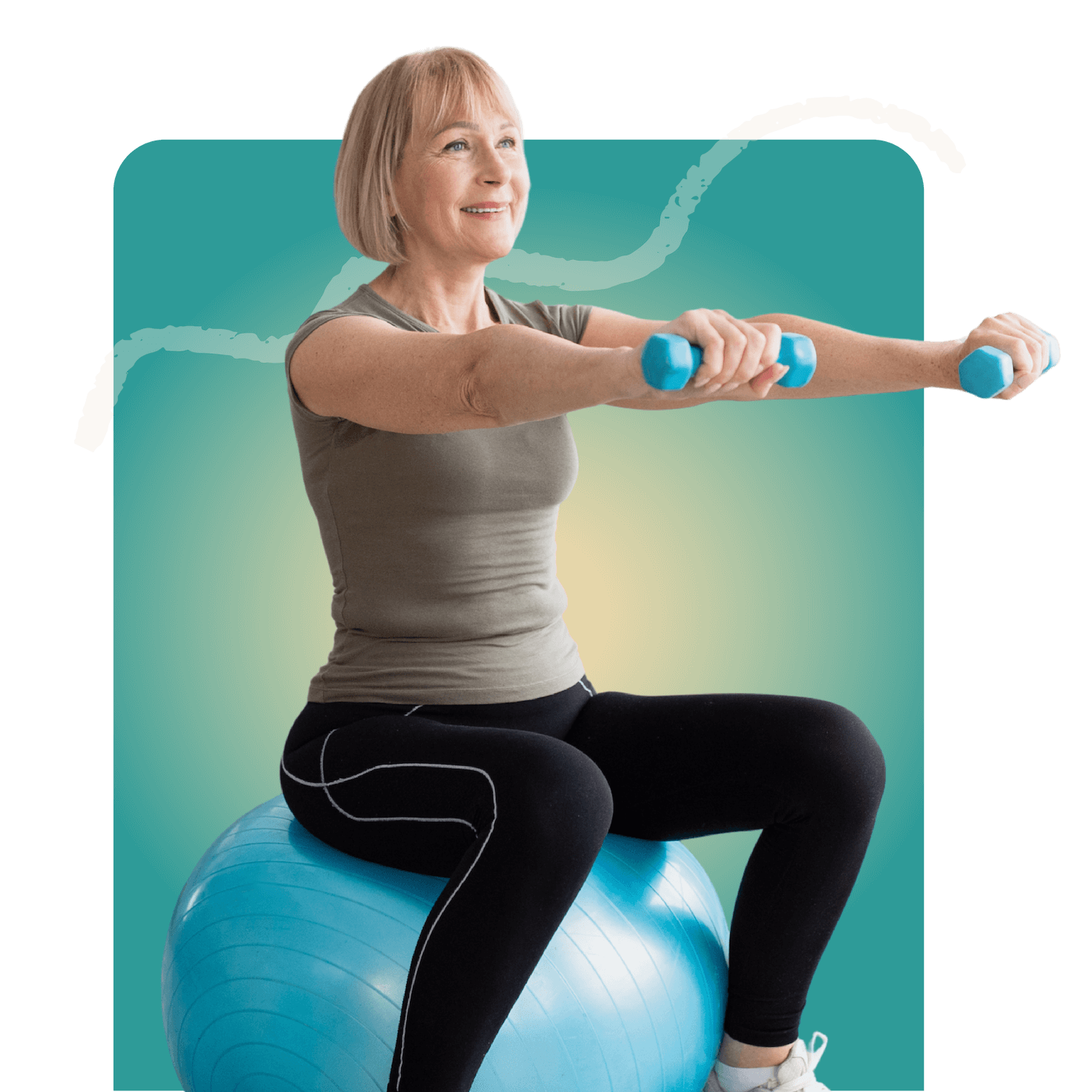
At Revive, we work with women at every stage of hysterectomy recovery — from women planning ahead for surgery to women addressing issues that developed years after. If you are in any of the following situations, we can help.
— Planning for an upcoming hysterectomy and wanting pre-surgery preparation
— Recently cleared by your surgeon but not feeling ready to return to normal activity
— Weeks or months post-surgery with ongoing pelvic pain, pressure, or weakness
— Years post-surgery with symptoms that never fully resolved
— Post-hysterectomy vault prolapse
— New urinary incontinence that developed after surgery
— Persistent incision pain, scar tissue restriction, or altered sensation
— Surgical menopause symptoms affecting pelvic health and overall function
— Core weakness or the inability to return to pre-surgery exercise
— Difficulty with intimacy or sexual function after surgery
— Feeling disconnected from your own body — like it is not quite yours anymore
If your surgery was a prolapse repair rather than a hysterectomy, the rebuilding is similar but the precautions are not, and that page is written for you.
Not sure whether your specific situation is something we can help with? Your Discovery Visit is exactly where we figure that out together — clearly and honestly.
When you pay directly for your care, every decision is made for one person: you.
Revive is a private-pay practice. Most insurance-based clinics cap your sessions, run every patient through the same protocol, and discharge you on their timeline — not yours. That system runs on volume: more patients per day, shorter visits, protocols instead of plans. It is not that the people working in it do not care. It is that the model does not let them.
At Revive, we operate outside that system entirely. That means a care plan built around where your recovery actually stalled, not what an insurance company will approve. That is the difference between treating a problem and unlocking a potential.
At a traditional insurance-based clinic
– Sessions are typically 30 minutes and often rushed
– You re-explain your history every visit, because there is no shared approach to your care
– Your discharge date is determined by your insurance, not your progress
– Treatment follows a standard protocol designed for the average patient
– Post-surgical pelvic floor and scar tissue work are rarely addressed specifically
At Revive PT & Pilates
– Longer one-on-one sessions, never rushed, delivered by a team that knows your history
– Your care plan is built entirely around your body, your surgical history, and your recovery goals
– Treatment continues as long as you need it — no arbitrary end dates
– Every specialist is trained by Dr. Dawn in the Pelvic & Core Reset™ Method
– We integrate pelvic floor rehabilitation, scar tissue work, and therapeutic Pilates for lasting recovery
If you have a PPO plan, we provide a superbill you can submit for possible out-of-network reimbursement. What comes back depends on your plan, so it is worth a quick call to your carrier.

What Starting Here Looks Like
A Clear Path Back to the Woman You Were Before Surgery
01
Start With a Discovery Visit
Your first step is a 60-minute, in-person visit at our Encinitas studio — a complete clinical evaluation with a women’s health specialist that includes the Revive Movement Screen™, a pelvic floor screen if needed, and a postural analysis. You tell us what you have been experiencing, how long it has been going on, and what you want your life to look like. We listen. Then we tell you honestly whether we can help and exactly what that would look like — and you take home a written action plan.
02
We Begin the Work Together
From your very first session we move forward from exactly where the Discovery Visit left off — pelvic floor function, scar tissue mobility, core strength and coordination, posture, and how you actually move. Hysterectomy recovery is never one tissue and never one system, so we do not treat it as one. Your plan is already built to address all of it.
03
We Build Your Program Around You
Based on your evaluation, our team builds a program designed specifically for your surgical history, your current stage of recovery, and your goals. Your plan may include pelvic floor manual therapy, scar tissue mobilization, neuromuscular retraining, and therapeutic Pilates on the reformer — whatever combination is right for you. And it progresses. Recovery is not finished when the symptoms quiet down. It is finished when you can do the thing again, so the load goes up deliberately, with somebody watching how your body handles each step before you take the next one.
Start With a Discovery Visit →
No referral needed. No pressure — just answers and a plan.

Proof
They Were Cleared Too. Here Is What Came After.
4,700+
Women helped since 2016
45+
Years of combined team experience
★★★★★
4.9
Across 155+ Google reviews
★★★★★
Monica, 54 — Hysterectomy Recovery
“I thought I would feel completely normal once I recovered from my hysterectomy, but months later, I still felt weak through my abdomen and pelvic floor. I was uncomfortable exercising, lifting, and even standing for long periods because I worried I might damage something internally. Revive helped me understand what my body had been through and guided me through rebuilding my strength safely. I can now exercise, lift, and get through a full day without constantly thinking about my surgery.”
★★★★★
Jacqueline, 61 — Hysterectomy Recovery
“After my hysterectomy, I struggled with pelvic pressure, core weakness, and a feeling that my body was no longer my own. I was embarrassed by some of my symptoms and wasn’t sure whether they were normal or something I would simply have to live with. From my first visit, I felt heard and understood. My treatment addressed the whole problem—not just one symptom. Today, I feel connected to my body again and confident doing the activities I had been avoiding.”
★★★★★
Heather, 49 — Hysterectomy Recovery
“My doctor told me that I was healed after my hysterectomy, but I didn’t feel healed. I still had discomfort, bladder leakage, and weakness whenever I tried to return to exercise. I worried that this was just part of getting older and that I would never feel like myself again. At Revive, I finally received clear answers and a plan designed specifically for me. I’m now back to walking, Pilates, traveling, and enjoying time with my family without organizing my life around my symptoms.”

100% Happiness Guaranteed
Yes, We Said It.
We are so confident in what we do and how we help women that our 100% happiness guarantee protects every program at Revive. If you are not 100% satisfied with the level of service you are provided, all you have to do is tell us that same day, and that session is on us. It's that simple.
Questions You May Have Before Starting Hysterectomy Recovery PT at Revive


-
Completely normal, and far more common than women are told. The six-week clearance is based on tissue healing, not functional recovery. It means your surgical sites have closed to the point where the risks of normal activity are low. It does not mean your pelvic floor has regained full function, your core has been rebuilt, or your scar tissue has been addressed. Feeling "not ready" at six weeks is not a failure on your part. It is an accurate reading of a gap the standard timeline leaves open.
-
If you've had the surgery, your surgeon sets that date, and it is usually somewhere around six weeks. What almost nobody explains is what the date actually means: it is about tissue healing. It tells you when activity is unlikely to cause harm. It does not tell you that your body is ready to do what it used to do.
In most cases specialized recovery physical therapy can begin as soon as your surgeon clears you. For some women we start earlier, with gentle scar tissue work and breathing-based pelvic floor work, with surgical clearance. For women with complications or specific concerns, we coordinate directly with the surgeon to find the safest starting point.
If your surgery is still ahead of you, there is work worth doing before it — see the question below on preparing for surgery.
If you are not sure whether it is the right time, your Discovery Visit is where we figure that out together. We would rather tell you honestly that you are not ready yet than start too early.
-
Most women are cleared for general activity at around six weeks, and your surgeon sets your date. What that clearance means is that movement is unlikely to harm your healing tissue. It is not a statement that your core and pelvic floor are ready to do what they did before.
Which is why the date is the less useful half of the question. Walking and gentle breathing work are generally fine early and are worth doing. The part that needs attention is what comes next — returning to working out, whether that is lifting, running, or anything else that loads your abdomen and pelvic floor, because that is where going back to your old routine at your old intensity tends to produce symptoms weeks later.
There is no single timeline for that part, and there should not be. It depends on what your body is actually doing now, which is something that can be assessed rather than guessed at.
-
The lifting restriction you were given after surgery had a reason and a timeframe. What usually does not happen is anyone checking, afterward, whether you still need it — which is why a lot of women are still following a six-week instruction years later.
We do not lift that restriction for you. That is a conversation with your surgeon. What we do is find out what your body can actually handle now. The Revive Movement Screen™ looks at how you load, how you breathe, and what your core and pelvic floor are doing while you move. From there the load goes up deliberately, with somebody watching how you respond to each step before you take the next one.
-
Absolutely. Many of our hysterectomy recovery clients come to us months, years, or even decades after their surgery, because the symptoms and limitations they have been living with never fully resolved. Pelvic floor dysfunction, scar tissue restriction, core weakness, and prolapse that developed after a hysterectomy stay treatable. Time does not close the door on them. They respond to the right work whether your surgery was six months ago or fifteen years ago.
-
Yes. Scar tissue stays responsive to manual therapy and movement for years after surgery. Women are often surprised that pulling, tightness, or restriction they have had for a decade can improve significantly. It is one of the highest-impact interventions in recovery and one of the most consistently skipped in standard post-surgical care.
-
It is common. Common is not the same as something you have to live with, and low back pain after a hysterectomy is often not a back problem at all.
The pelvic floor is part of how your trunk stabilizes. When it isn't doing its share, your low back compensates. And the pelvic floor belongs to a different specialty than the low back — so nobody's exam included both, and the thing driving your pain sat in the gap between them. After a hysterectomy that gap widens, because the support structure that used to include the uterus has to reorganize without it.
That is exactly what a full evaluation is for: looking at the back and the pelvic floor in the same exam rather than in two different appointments.
-
Yes. If your hysterectomy included oophorectomy — removal of one or both ovaries — you experienced surgical menopause. Depending on your age, that can be a more sudden and severe hormonal transition than the natural one. Estrogen decline affects connective tissue, bone density, pelvic support, muscle function, and overall recovery capacity, so we account for your hormonal context at every stage and build a program that supports your body through it. We also coordinate with your physician when appropriate about hormone replacement therapy, nutrition, and other factors that affect your recovery.
-
Yes, and it is one of the more common reasons women come to us.
Pain with intimacy, dryness, loss of sensation, tightness, or simply not trusting your body the way you used to are all things that can change after a hysterectomy. They can come from pelvic floor tension, from scar tissue, from nerve sensitivity, from hormonal shifts, or from some combination — and which one it is changes what helps. Most of these improve significantly with the right care.
This gets talked about the way any other part of your recovery gets talked about, by a specialist who has had the conversation many times before. If it is part of what you want back, it is part of what we work on.
-
Yes, and pre-surgery preparation is one of the most underused parts of hysterectomy recovery. Women who complete specialized pre-surgery PT consistently have faster recovery times, fewer post-surgical complications, and better long-term outcomes. We assess your current pelvic floor and core function, identify weakness or dysfunction that could affect your recovery, and build a targeted program to strengthen what needs strengthening before surgery. We also walk you through what to expect: how to position yourself in bed, how to breathe and move safely in the first weeks, and what to watch for. You go into surgery informed and prepared, with a plan already in place for what comes after.
-
Most women notice meaningful symptom improvement within 60 days. How much and how quickly depends on how recent your surgery was, what you are addressing, and how your body responds. At your Discovery Visit we will give you an honest picture based on your specific situation rather than a generic estimate.
-
No referral is needed. California is a direct-access state. If your care plan benefits from working with your gynecologist, surgeon, or other specialist, we're always happy to collaborate with your existing care team — but you don't need to wait for anyone's permission to get started.
-
Your first step is a 60-minute, in-person Discovery Visit at our Encinitas studio. You'll sit down with a women's health specialist for a complete clinical evaluation — the Revive Movement Screen™, a pelvic floor screen if needed, and postural analysis — looking at pelvic floor function, core coordination, scar mobility, breathing mechanics, and how you move and load. You tell us what you've been experiencing, how long it's been going on, what you've already been told, and what you want your life to look like. We listen, give you an honest answer about whether we can help, and build a personalized program plan in the room that you take home as a written action plan. No pressure, no commitment — just clarity about exactly what working with us would look like.
-
There is no other practice in North County San Diego that combines women's health physical therapy with therapeutic Pilates in one integrated program. And every client we work with is a woman over 40.
Every specialist on our team is trained by Dr. Dawn Andalon, DPT, in the Pelvic & Core Reset™ Method. We specialize in hysterectomy recovery specifically — pre-surgery preparation, post-surgical rehabilitation, and long-term recovery years after surgery. Sessions are one-on-one and unhurried, and because we're a private-pay practice, every decision is based on what your body needs rather than what an insurance company will approve.
-
Revive PT & Pilates is a private-pay practice, which means we don't bill insurance directly. We're considered out-of-network for PPO plans on our physical therapy services.
If you have a PPO plan, we provide a superbill you can submit for possible out-of-network reimbursement. What comes back depends on your plan, so it's worth a quick call to your carrier.
Medicare does not cover the services we provide, so there is nothing for Medicare to reimburse. We do not provide superbills to Medicare beneficiaries, including Medicare Advantage plans.
Our private-pay model is what allows longer, more personalized one-on-one sessions without the restrictions that come with insurance-based care. If you have questions about fees, text or call us at (760) 301-5235 and we'll walk you through the options — no pressure, no surprises.
For the full picture — including HSA and FSA, and exactly what to ask your insurance company — see our Cost & Insurance page.
Other Conditions We Treat
If Something Else Is Going On Too, We Treat That Here as Well.
Pelvic Organ Prolapse
If your surgery was a prolapse repair rather than a hysterectomy, the rebuilding is similar but the precautions are not.
Urinary Incontinence
If the main thing you notice is leaking rather than pressure or heaviness, that is usually stress incontinence.
Menopause & Perimenopause
A body changing on its own schedule, and nobody explaining what to do about it.
Osteoporosis & Bone Density Loss
Building strength safely when you have been told to be careful.
Cleared at Six Weeks.
Now What?
GET THE GUIDE
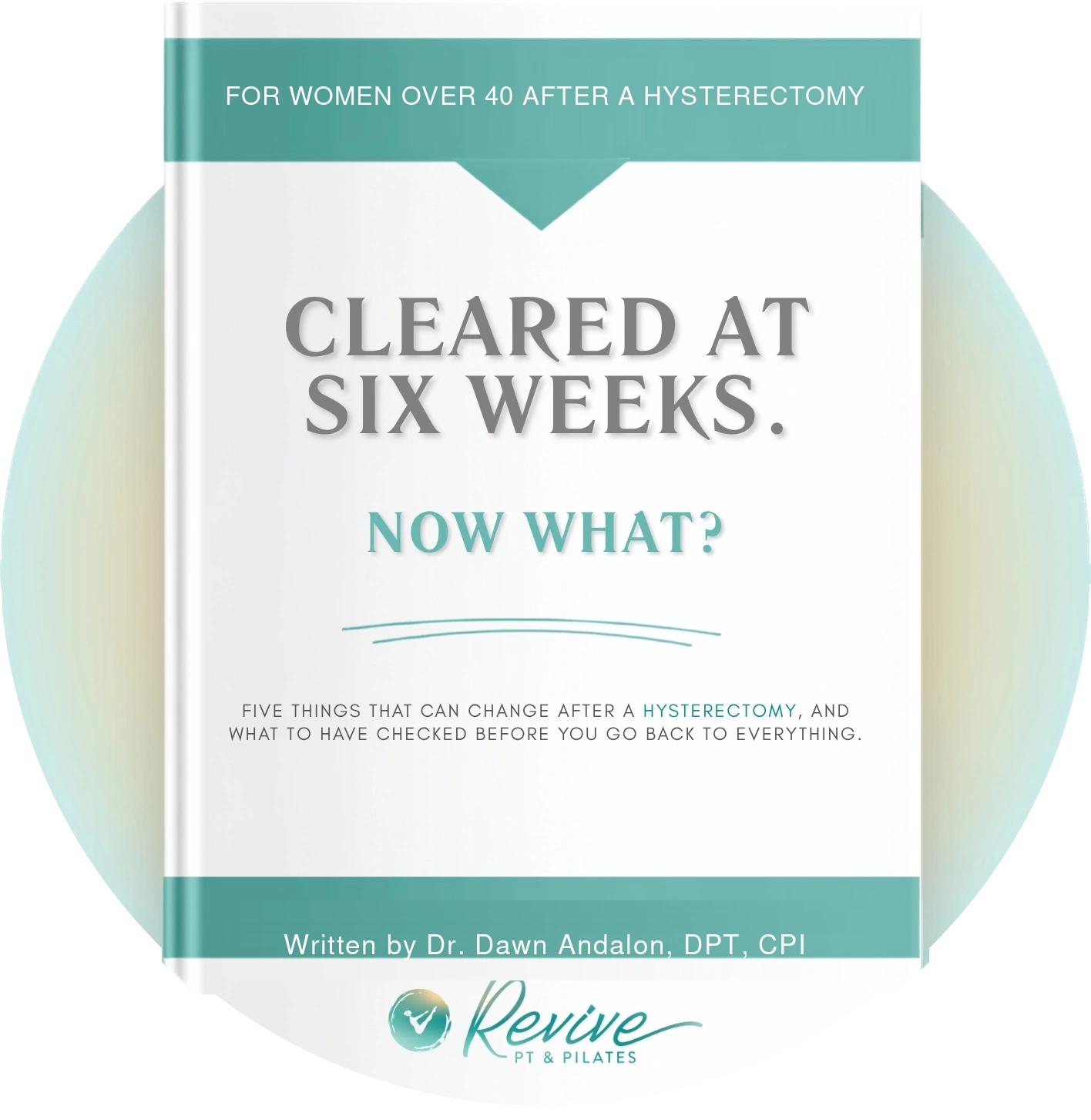

The incisions healed, somebody said you were fine, and nothing was scheduled for the part that comes after. Dr. Dawn Andalon walks you through five things that can change after surgery — leaking, intimacy, prolapse risk, your scar, and why six weeks may not be enough — plus what to practice before surgery and the questions that tell you whether you're really ready to return to normal activity. Practical. Specific.

One Studio in Encinitas. Women Drive Here from Across North County.
Revive PT & Pilates is a single studio in Encinitas, CA, in the heart of North County San Diego. Women drive to us from across the county — Carlsbad, Solana Beach, Del Mar, La Jolla, Leucadia, Cardiff by the Sea, Rancho Santa Fe, and Oceanside — for hysterectomy recovery physical therapy built around what the six-week clearance was never designed to restore.
Visit us at 681 Encinitas Blvd, Encinitas, CA 92024. Free parking is available directly in front of the building. Physical therapy and integrated Pilates sessions take place in Suite 308; Pilates group classes are in our adjacent studio, Suite 305. When you arrive, look for Suite 308 — our team will direct you from there.
No referral is needed — California is a direct-access state.
If you’re traveling from further in San Diego County and want to confirm we’re the right fit before making the drive, call or text us first at (760) 301-5235 — we’re happy to answer your questions.

You Have Waited Long Enough
Six Weeks Was Where It Started.
Not Where It Ended.
Recovery is not the absence of symptoms. It is knowing what your body can do because somebody actually checked — and then picking things up, putting them down, and booking the trip without checking with yourself first.
The women who complete this program tell us they stopped thinking about the surgery. That is what is available on the other side of a Discovery Visit, and it starts with one honest hour in our studio.
Most women tell us it was the first time they ever felt truly listened to.
Start With a Discovery Visit →
No referral needed. No pressure — just answers and a plan.