

Menopause & Perimenopause — Encinitas, CA
You Were Told This Is Just Menopause — and to Live With It. You Don't Have To.
Menopause and perimenopause physical therapy for women over 40 in Encinitas, CA.
For women navigating the real physical changes of perimenopause and menopause — the pelvic floor symptoms, the new aches, the strength that seems to be slipping — there is a specialized path forward that your 7-minute gynecology appointment was never designed to give you.
Start With a Discovery Visit →
No referral needed. No pressure — just answers and a plan.
Dr. Dawn Andalon, DPT · Creator of the Pelvic & Core Reset™ Method · Practicing in North County since 2016
Five things went wrong at once. Dr. Dawn on why it is actually one.
01
Root-Cause Care, Not
Symptom Management
02
Every Specialist Personally
Trained by Dr. Dawn in the
Pelvic & Core Reset™ Method
03
Integrated PT & Therapeutic
Pilates — The Only Practice of
Its Kind in North County
You Have Been Showing Up for Everyone Else. Powering Through the Leaking. The Aches. The Nights You Cannot Sleep. The Body That No Longer Feels Like Yours. And You Are Quietly Running Out of Gas.
Maybe it started with one symptom. A little leaking. A new ache. A week of bad sleep. And you told yourself it was stress, or a busy season, or a bad night.
Then it became two symptoms. Then five. Then you realized the list was getting longer, not shorter — and nobody was giving you a real explanation for any of it.
You went to your gynecologist. Seven minutes. A prescription, maybe. "This is just menopause." You went home and Googled. You tried the supplements. The yoga. Maybe the HRT. Some things helped a little. Nothing fixed the underlying feeling — that your body is no longer behaving like your body.
You are not losing yourself. You are not broken. You are in the middle of the biggest hormonal shift of your adult life, and almost no one has built care for exactly what you are going through. We have.
If this sounds like you…
You are not imagining it. These are not random, unrelated complaints. They are connected — and they have a name.
- — You are leaking when you laugh, cough, sneeze, or exercise — and it started (or got worse) around perimenopause
- — Your back, hips, or pelvis hurt in ways they never did before, and nothing you have tried is fixing it
- — You feel a pressure, heaviness, or bulge “down there” that was not there a few years ago
- — Sex has become uncomfortable, painful, or something you avoid
- — You were told “this is just menopause” and given a prescription for HRT — or nothing at all — and left to figure the rest out on your own
- — You are losing muscle, losing bone density, or watching your body change in ways that feel out of your control
- — You feel less stable on your feet, less confident in your movement, less at home in your own body
- — You are doing “all the right things” — walking, yoga, maybe even Pilates — and you still do not feel like yourself
We are here to tell you — this is not something you have to wait out. What is happening in your body is physical, it responds to treatment, and you do not have to accept it as the new shape of your life.

What Is Actually Happening to Your Body in Perimenopause and Menopause
Every one of these is a real, physiological consequence of the hormonal shift your body is moving through.
Perimenopause is the four-to-ten-year window before your final period when your hormones — especially estrogen and progesterone — begin declining and fluctuating unpredictably. Menopause is the day twelve months after your last period. Everything after that is post-menopause.
Most women are told that menopause is about hot flashes, mood changes, and sleep disruption. That is true. But that is not the whole story — not even close.
Estrogen is a structural hormone. It supports the tissue of your pelvic floor, the collagen in your connective tissue, the density of your bones, the coordination of your core, the lubrication of your joints, and the elasticity of the ligaments that hold your pelvic organs in place.
When estrogen declines, every one of those systems is affected at the same time.
That is why symptoms that seem unrelated — leaking, back pain, pelvic pressure, painful sex, new joint aches, loss of strength — so often show up together during perimenopause and menopause. They are not unrelated. They are the connected downstream effects of a whole-body hormonal shift that nobody prepared you for.
And here is what most women are never told: these changes are not things you have to passively endure. They are things your body can respond to — when you give it the right inputs.

What Waiting Costs
Why Your Gynecologist's Seven-Minute Appointment Is Not Built to Solve This
Your gynecologist is an excellent physician. She is also seeing thirty women a day, has seven minutes to address your concerns, and was trained to manage hormones — not to evaluate pelvic floor function, address the musculoskeletal consequences of estrogen loss, or build a movement-based protocol for your specific body.
So you leave her office with one of three things: a prescription for HRT, a referral to a specialist you will wait three months to see, or the words "this is just part of menopause — try to exercise more."
None of those are wrong. All of them are incomplete.
HRT can help with systemic symptoms. It cannot, by itself, rehabilitate a pelvic floor that has lost tone and coordination. It cannot rebuild the strength and bone density you are losing. It cannot restore the core–pelvic floor–diaphragm pressure system that midlife hormonal shifts so often disrupt.
That is not a hormone problem. That is a specialty physical therapy problem — and it needs a specialty physical therapy solution.
Most generalist PT clinics are not built for this either. They are built for post-surgical rehab, sports injuries, and insurance-based thirty-minute sessions where the pelvic floor is never evaluated and the word "menopause" is rarely mentioned. You need someone whose entire practice is built around women exactly where you are.
And the transition does not wait while you look. Bone density, pelvic floor tone, and core coordination all change through perimenopause whether or not anyone is helping you manage them. Waiting until menopause itself often means addressing problems that could have been prevented, or significantly lessened, with earlier intervention.
It is never too late to start. It is just easier the earlier you do.

How We Treat It
How We Treat Menopause at Revive
At Revive PT & Pilates, our women's health specialists focus on the exact musculoskeletal and pelvic floor consequences of perimenopause and menopause that generalist care is not built to address.
Every woman who comes to us for menopause-related care begins with the Revive Movement Screen™ — a full evaluation of what estrogen decline is actually doing in her body. Not a protocol, not a symptom checklist, but a personalized clinical picture of where your system is compensating, where it is struggling, and what it is trying to tell you.
From there, your care plan is built around the Pelvic & Core Reset™ Method — Dr. Dawn Andalon's proprietary clinical framework for rebuilding the pressure system that midlife hormonal changes so often disrupt. It integrates pelvic floor physical therapy, therapeutic Pilates on the reformer, progressive resistance training calibrated for bone density, and the specific breathing and coordination work that restores how your core, pelvic floor, and diaphragm work together as one system.
What you will not get is a generic "menopause class." What you will get is one-on-one care in a private space, with a team trained in the same method, built around your body — not the average woman's body, not the textbook's body, yours.
This is what women came to us for in the first place. Specialty care for the specific changes nobody else seems to take seriously.
When you pay directly for your care, every decision is made for one person: you.
Revive is a private-pay practice. Most insurance-based clinics cap your sessions, run every patient through the same protocol, and discharge you on their timeline — not yours. At Revive, we operate outside that system entirely. That means longer one-on-one sessions delivered by a team that knows your history and is all trained in the same method — and a care plan built around the specific consequences of perimenopause and menopause in your body, not what an insurance company will approve.
At a traditional insurance-based clinic
— Sessions are typically 30 minutes and often rushed
— You re-explain your history every visit, because there's no shared approach to your care
— Your discharge date is determined by your insurance — not your progress
— Treatment follows a standard protocol designed for the average patient
— Hormonal changes, pelvic floor function, and bone-density-appropriate loading are rarely addressed
At Revive PT & Pilates
— One-on-one sessions, never rushed, delivered by a team that's all trained in the same method
— Your care plan is built entirely around your body, where you are in the transition, and your goals
— Treatment continues as long as you need it — no arbitrary end dates
— Every specialist is trained by Dr. Dawn in the Pelvic & Core Reset™ Method
— We integrate pelvic floor PT, therapeutic Pilates, and progressive resistance training calibrated for your bone density
If you have a PPO plan, we provide a superbill you can submit for possible out-of-network reimbursement. What comes back depends on your plan, so it's worth a quick call to your carrier.
What Starting Here Looks Like
A Clear Path Back to Sleeping, Moving, and Feeling Like Yourself.
Start With a Discovery Visit
Your first step is a 60-minute, in-person visit at our Encinitas studio — a complete clinical evaluation with a women's health specialist that includes the Revive Movement Screen™, a pelvic floor screen if needed, and a postural analysis. You tell us what you have been experiencing, how long it has been going on, and what you want your life to look like. We listen. Then we tell you honestly whether we can help and exactly what that would look like — and you take home a written action plan.
We Begin the Work Together
From your very first session, you'll work one-on-one with a women's health specialist — and because we meet as a team about every client, whoever you're with already knows your story and your plan from your Discovery Visit. No starting over. No repeating yourself. We move forward from exactly where the Discovery Visit left off, addressing your pelvic floor function, core coordination, bone-loading capacity, posture, and the specific ways estrogen decline is showing up in your body.
We Build Your Program Around You
Based on your evaluation, our team builds a program designed specifically for your body, where you are in the menopause transition, and your goals. Every session moves you forward intentionally. Nothing is generic. Nothing is guesswork. Every decision is pointed at the same destination — the life you came here to reclaim.
Start With a Discovery Visit →
No referral needed. No pressure — just answers and a plan.

Proof
Women Who Stopped Waiting for It to Pass
45+
Years of Combined Team Experience in PT & Pilates
4,700+
Women Helped Across North County San Diego Since 2016
★★★★★
4.9 Stars
Across 155+ Google Reviews
★★★★★
Catherine, 54 — Menopause
"I spent two years being told 'this is just menopause' by every provider I saw. The pelvic pressure, the leaking, the back pain that showed up out of nowhere — all of it dismissed. Dr. Dawn was the first person who looked at me like a whole system instead of a list of complaints. Four months into my program I am doing things I had quietly stopped doing. I am lifting weights again. I am not planning my day around where the bathroom is. I feel like I got myself back."
★★★★★
Deborah, 55 — Perimenopause
"It wasn't one thing — it was everything at once. The leaking, the back pain that came out of nowhere, the nights I couldn't sleep, a body that suddenly didn't feel like mine. My doctor said 'this is just perimenopause' and gave me seven minutes. Revive was the first place that connected all of it to the same hormonal shift and built one program to address the whole picture. Four months in, I'm sleeping through the night, the leaking is gone, and I'm lifting weights again. I finally feel like myself."
★★★★★
Rosemary, 60 — Post-Menopause
"I thought I'd missed my window — I was years past my last period and assumed it was too late to change anything. My doctor mentioned bone loss and told me to 'exercise more,' with no plan for how. At Revive, they built a program around exactly what my body needed at this stage: pelvic floor, core, and the kind of strength training that actually protects your bones. I'm stronger at 60 than I was at 50, and I stopped feeling like my body was something happening to me."

100% Happiness Guaranteed
Yes, We Said It.
We are so confident in what we do and how we help women that our 100% happiness guarantee protects every program at Revive. If you are not 100% satisfied with the level of service you are provided, all you have to do is tell us that same day, and that session is on us. It's that simple.
Questions You Might Have About Physical Therapy for Menopause


-
Yes — for the specific symptoms that are musculoskeletal or pelvic floor in nature, physical therapy is often the treatment that actually addresses them. Hot flashes, mood changes, and sleep disruption are typically managed with hormones, lifestyle changes, or medical care. But the symptoms that tend to frustrate women most — incontinence, pelvic pressure, back and hip pain, painful sex, core weakness, bone density loss, joint stiffness, frozen shoulder, loss of movement confidence — are all things physical therapy is specifically designed to address. At Revive, every treatment plan is built around the exact ways estrogen decline is showing up in your body. Your Discovery Visit is where we give you an honest assessment of what physical therapy can realistically do for your specific symptoms.
-
Yes — and perimenopause is actually the ideal time to start. Perimenopause is the four-to-ten-year window before your final period when hormones are declining and fluctuating, and it is when most of the musculoskeletal and pelvic floor changes actually begin. Waiting until menopause itself often means addressing problems that could have been prevented or significantly lessened with earlier intervention. If you are experiencing new or worsening symptoms — incontinence, pelvic pressure, unexplained back or hip pain, sleep disruption, core weakness, or a general sense that your body is changing in ways you can't quite name — perimenopause is exactly when to get evaluated.
-
Most women notice meaningful symptom improvement within 60 days. Some symptoms — urinary urgency, pelvic pressure — often improve sooner than that. Others, like bone density and deep core strength, need longer and more progressive work, and they are measured differently. How quickly you get there depends on which symptoms you're working on, how long they have been developing, and how consistently you do the home program. At your Discovery Visit, we will give you a realistic picture based on your specific situation, not a generic estimate.
-
Neither is required — and neither is enough on its own. Hormone replacement therapy is a medical decision between you and your physician, and it can meaningfully help with systemic symptoms like hot flashes, mood changes, and sleep. What HRT cannot do is rehabilitate a pelvic floor that has lost tone, rebuild the strength and bone density you are losing, or restore the core–pelvic floor–diaphragm pressure system that midlife hormonal shifts so often disrupt. Those require targeted physical therapy — not hormones. We work with women who are on HRT, women who have chosen not to take HRT, and women who are still deciding. What we care about is addressing the specific musculoskeletal and pelvic floor consequences of the menopause transition in your body. Many of our clients find that combining HRT with specialty physical therapy produces better results than either approach alone.
-
Yes — with the right guidance, and the right kind of exercise. In fact, the right exercise is one of the most important things you can do during the menopause transition. Weight-bearing strength training is what protects bone density. Pelvic floor–integrated movement preserves continence and core function. Breathwork and mobility protect your joints. What is not safe is continuing to exercise the way you did in your thirties without accounting for how your body has changed — or avoiding exercise entirely because you're unsure what is safe. Both are common, and both lead to worse outcomes. At Revive, we teach you exactly how to move, breathe, lift, and exercise in a way that supports the specific changes happening in your body during this transition. Most of our clients are doing more than they were before they started — not less.
-
Almost never. In fact, one of the most common things our clients say after a Discovery Visit is that they feel permission to keep moving in ways they had quietly started avoiding out of fear of "making it worse." Your program is not about limiting you. It is about teaching your body how to do what you want to do — safely, efficiently, and in a way that supports the transition you are going through. There may be short periods where we modify a specific activity if it is directly worsening a symptom we are working on, but the goal is always to expand what you can do, not shrink it. If you love the gym, we keep you at the gym. If you love hiking, we keep you hiking. If you love Pilates, we have an entire Pilates studio.
-
It is absolutely not too late. We work with women at every stage of the menopause transition — perimenopause, menopause, and post-menopause — including women in their sixties, seventies, and beyond. The changes that happen during menopause do not stop being responsive to the right inputs once your final period has passed. Bone density, pelvic floor function, strength, mobility, and core coordination can all be meaningfully improved at any point in your life, and the earlier you start, the more momentum you build. Women who begin with us ten or fifteen years after their final period consistently tell us they wish they had started sooner — and they are doing things they had long since given up on.
-
It often arrives in the same years. Frozen shoulder is a shoulder that slowly stiffens and hurts until everyday things become hard — reaching into the fridge or a high cupboard while you cook, fastening a bra, washing and doing your hair. It is most common in women between 40 and 60. Researchers are studying whether the hormonal changes of menopause play a part. That question is not settled yet, and we will not pretend it is.
What is clear is that waiting it out is not a reliable plan. For some women the stiffness lingers for years. Frozen shoulder also moves through stages, and what helps in one can work against you in another. Pushing hard into painful stretches early on can make things worse; the stiff stage needs a different approach altogether.
So we start by working out which stage you are in and what else is going on. Diabetes and thyroid conditions are both linked to frozen shoulder and are worth raising with your physician, as are injections, which help some women alongside therapy. From there, we build your plan around the specific movements you have lost. Your Discovery Visit is where that begins.
-
Your first step is a 60-minute, in-person Discovery Visit at our Encinitas studio. You'll sit down with a women's health specialist for a complete clinical evaluation — the Revive Movement Screen™ looks at pelvic floor function, core coordination, bone-loading capacity, posture, breathing mechanics, and the specific ways the menopause transition is showing up in your body. You tell us what you've been experiencing, how long it's been going on, what you've already been told, and what you want your life to look like. We listen, give you an honest answer about whether we can help, and build a personalized program plan in the room that you take home as a written action plan. No pressure, no commitment — just clarity about exactly what working with us would look like.
-
There is no other practice in North County San Diego that combines women's health physical therapy with therapeutic Pilates in one integrated program. And every client we work with is a woman over 40.
Every specialist on our team is trained in Dr. Dawn Andalon's Pelvic & Core Reset™ Method. We assess pelvic floor function, bone-loading capacity, and the specific ways estrogen decline is showing up in your body as part of every menopause evaluation — not just strength or flexibility in isolation.
Our therapeutic Pilates program provides core support, pelvic floor integration, and progressive resistance training calibrated for bone density that most clinics simply cannot offer. Our sessions are one-on-one and unhurried, delivered by a team that knows your history and is all trained in the same method. And because we are a private-pay practice, every decision we make is based entirely on what your body needs — not what an insurance company will approve.
-
Revive PT & Pilates is a private-pay practice, which means we do not bill insurance directly.
If you have a PPO plan, we provide a superbill you can submit for possible out-of-network reimbursement. What comes back depends on your plan, so it's worth a quick call to your carrier.
Medicare does not cover the services we provide, so there is nothing for Medicare to reimburse. We do not provide superbills to Medicare beneficiaries, including Medicare Advantage plans.
If you have questions about fees, text or call us at (760) 301-5235 and we'll walk you through everything — no pressure, no surprises.
For the full picture — including HSA and FSA, and exactly what to ask your insurance company — see our Cost & Insurance page.
-
No referral is needed. California is a direct-access state. If your care plan benefits from working with your gynecologist, primary care physician, or other specialist, we are always happy to collaborate with your existing care team — but you do not need to wait for anyone's permission to get started.
Other Conditions We Treat
Menopause Can Show Up in Six Different Ways. We Treat Every One.
We treat the full range of conditions that affect women over 40, and we bring the same root-cause approach to all of them. Many are driven by or intensified during the menopause transition — prolapse that worsened through perimenopause, incontinence that started around it, back pain connected to connective tissue changes, bone density loss. If you came here for menopause and suspect one of these is part of your picture too, the Discovery Visit is where we figure that out.
Back Pain
Get back to the hike, the gym, the morning walk — without planning your day around your back.
Learn more →Sciatica
Stop calculating every car ride and every step. Your body wasn't designed to live like this.
Learn more →Incontinence
Laugh freely. Sneeze without bracing. Take the road trip. That's what the other side looks like.
Learn more →Osteoporosis
Move through the world without fear of your own body. That's what we are working toward.
Learn more →Pelvic Organ Prolapse
Surgery isn't the only conversation. Find out what's actually possible first.
Learn more →Not sure whether your symptoms are menopause-related or something else? Your Discovery Visit is exactly where we figure that out together — clearly and honestly. If pelvic floor dysfunction, pelvic pain, or painful intercourse is part of your picture, that's what our pelvic floor program is built for.
Get the Guide
Why Everything Changed at Once
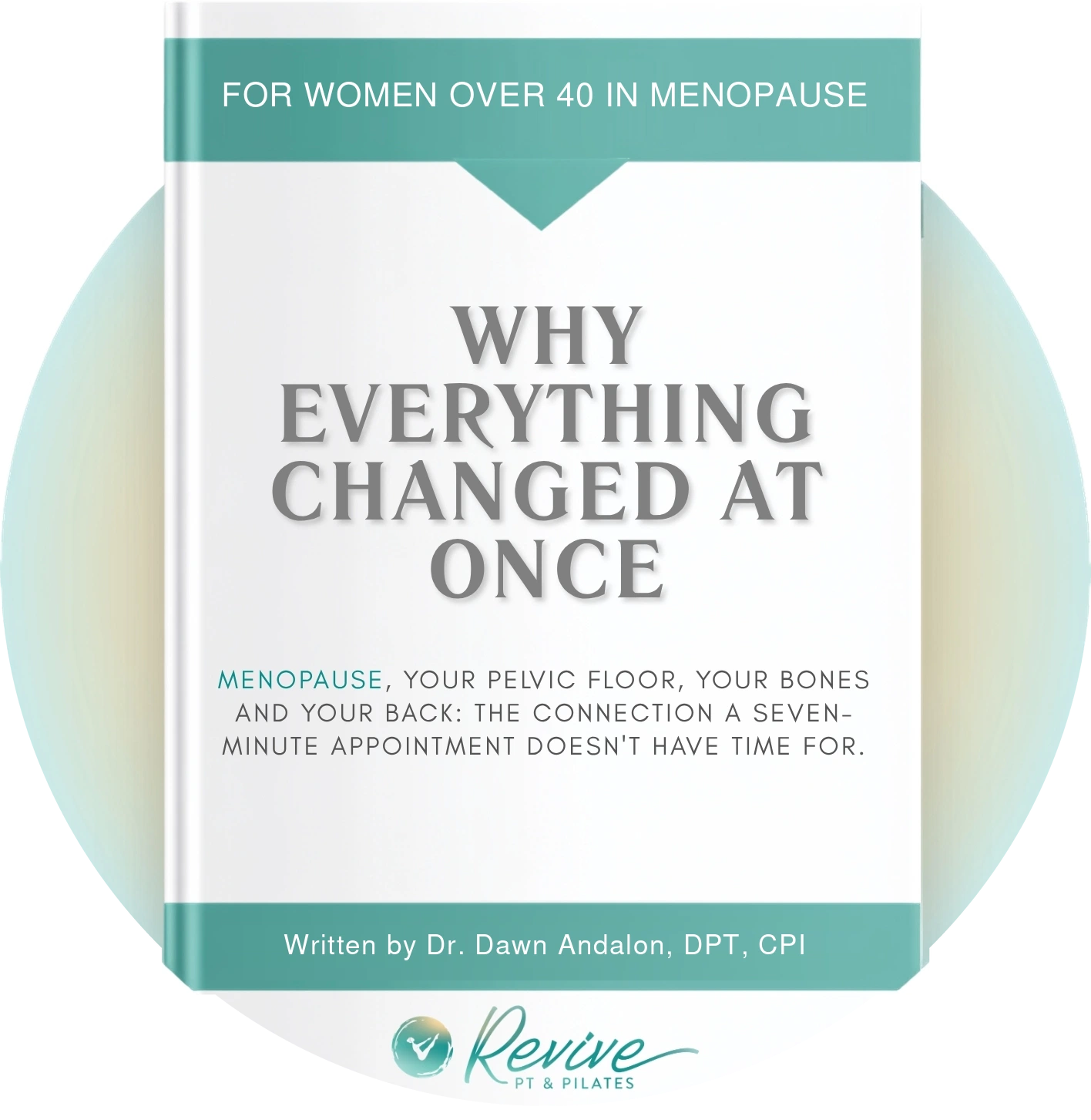

Your back started aching. You leaked when you sneezed. A scan came back with a word you hadn’t heard before. Each one got its own appointment, and nobody put them in the same sentence. Dr. Dawn Andalon connects the dots between menopause, your pelvic floor, your bones and your back — and explains what hormone therapy can and cannot do about any of it. Written for women who want to understand what actually changed, not just manage it.

One Studio in Encinitas. Women Drive Here from Across North County.
Revive PT & Pilates is a single studio in Encinitas, CA, in the heart of North County San Diego. Women drive to us from across the county — Carlsbad, Solana Beach, Del Mar, La Jolla, Leucadia, Cardiff by the Sea, Rancho Santa Fe, and Oceanside — for menopause and perimenopause physical therapy built around what is actually driving their symptoms.
Visit us at 681 Encinitas Blvd, Encinitas, CA 92024. Free parking is available directly in front of the building. Physical therapy and integrated Pilates sessions take place in Suite 308; Pilates group classes are in our adjacent studio, Suite 305. When you arrive, look for Suite 308 — our team will direct you from there.
No referral is needed — California is a direct-access state.
If you’re traveling from further in San Diego County and want to confirm we’re the right fit before making the drive, call or text us first at (760) 301-5235 — we’re happy to answer your questions.

You Have Waited Long Enough
This Is Not the Part Where You Disappear.
You sleep through the night. You lift weights without hesitating. You say yes to the hike, the trip, the class you stopped going to. Menopause is still happening. It has simply stopped being the thing that decides.
The women who complete this program tell us they stopped waiting for menopause to just pass. That is what is available on the other side of a Discovery Visit, and it starts with one honest hour in our studio.
Most women tell us it was the first time they ever felt truly listened to.
Start With a Discovery Visit →
No referral needed. No pressure — just answers and a plan.