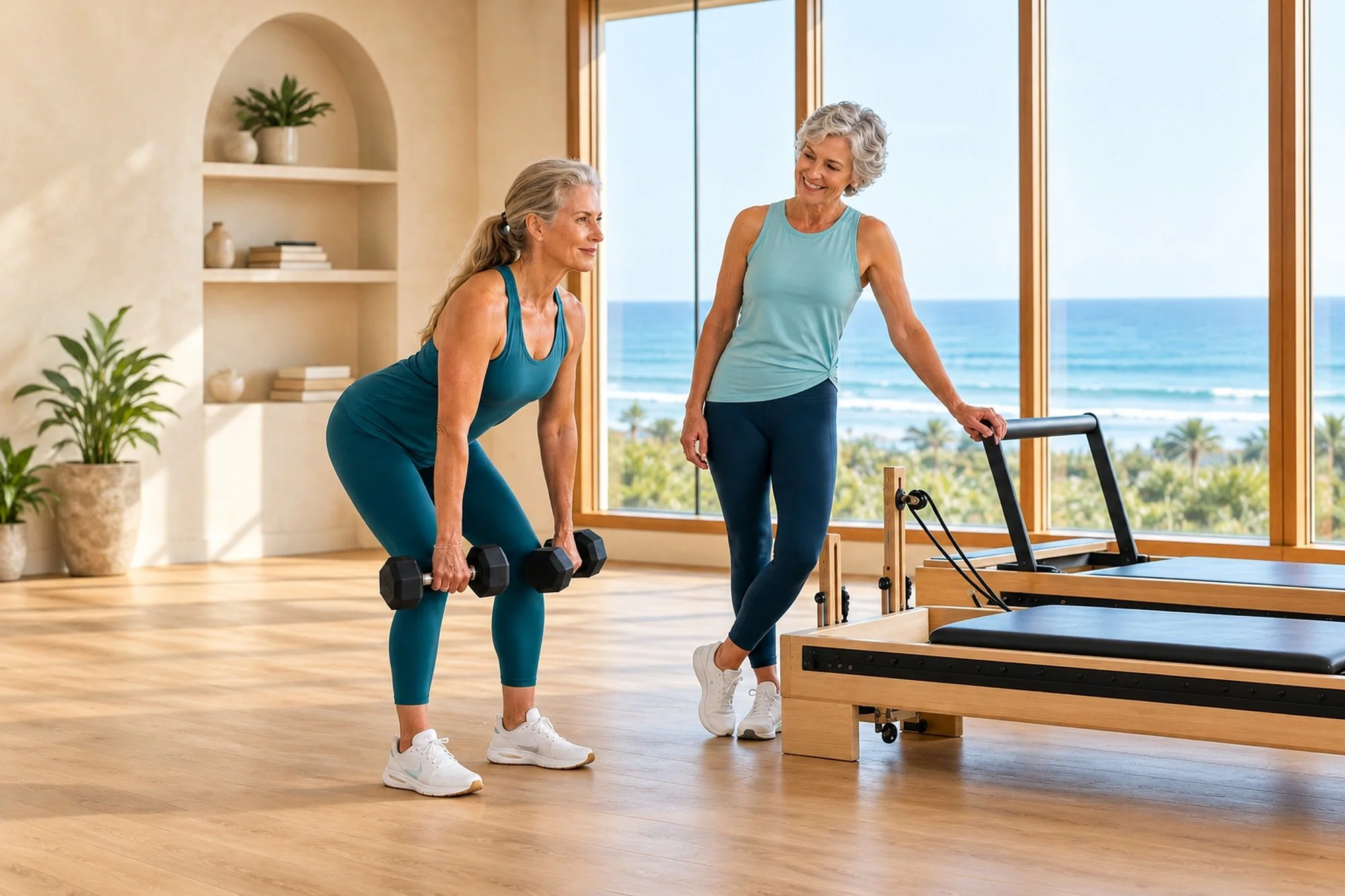
If you're a woman over 40, you've probably noticed your body responding differently than it used to. The workouts that once kept you toned don't seem to work the same way. Weight settles in new places. Energy dips earlier in the day. Maybe you've even been told that aches, stiffness, or a slower metabolism are "just part of getting older."
They're not — and strength training for women over 40 is one of the most well-researched, effective ways to prove it.
At Revive PT & Pilates in Encinitas, CA, we work with women every day who are navigating perimenopause, menopause, osteoporosis, and the general physical changes of midlife. And one theme comes up again and again: strength training isn't optional at this stage of life. It's foundational. This guide breaks down exactly why strength training matters more than ever after 40, what the research says, how to do it safely (especially if you're managing pelvic floor issues, back pain, or low bone density), and how to build a program that actually fits the body you have right now.
Why Strength Training Changes After 40
Starting in your late 30s and accelerating through your 40s and 50s, your body begins a natural process called sarcopenia — the gradual loss of muscle mass and strength that occurs with age. Left unaddressed, sarcopenia can lead to reduced mobility, slower metabolism, higher injury risk, and a loss of independence later in life.
For women, this process speeds up significantly during perimenopause and menopause. As estrogen declines, women lose muscle mass and bone density at a faster rate than men experience during the same decades of life. Estrogen plays a direct role in maintaining bone turnover and muscle protein synthesis, so when levels drop, the effects on strength and skeletal health become more pronounced.
The encouraging news: this decline is not inevitable. Research consistently shows that resistance and strength training can slow and even reverse age-related muscle loss, and help protect bone density — regardless of whether you’ve ever lifted a weight before.
The Real Benefits of Strength Training for Women Over 40
1. Protects and Rebuilds Bone Density
The risk of osteoporosis rises sharply for women after menopause due to declining estrogen levels. Weight-bearing and resistance exercise is one of the few interventions shown to meaningfully slow bone loss — and in some studies, moderate-to-heavy strength training has even helped postmenopausal women increase bone density in the spine and hips. This is exactly why we treat osteoporosis as a movement issue, not just a medication issue, in our osteoporosis physical therapy programs in Encinitas.
2. Preserves and Builds Lean Muscle
Contrary to a common myth, strength training after 40 does not create a bulky physique. For women, resistance training typically leads to a leaner, more toned body composition with reduced body fat — not added bulk. Muscle is also metabolically active tissue, meaning more of it supports a healthier metabolism at rest.
3. Supports Heart Health
Strength training isn't just for bones and muscles. A 2024 study in the Journal of the American College of Cardiology found that women who did regular strength training had a 30% lower risk of dying from cardiovascular disease than women who didn't. Combined with cardiovascular exercise, resistance training rounds out a heart-healthy routine.
4. Improves Balance and Reduces Fall Risk
As we age, balance and coordination naturally decline, increasing the risk of falls and fractures. Strength training — particularly exercises that challenge stability, like single-leg work and controlled Pilates reformer movements — trains the small stabilizing muscles that keep you steady on uneven ground, stairs, or a slippery sidewalk.
5. Eases Joint Pain
It may seem counterintuitive, but building strength around a joint is one of the most effective ways to reduce joint pain. Stronger muscles absorb more load, taking pressure off the joint itself. This is especially relevant for women managing knee, hip, or lower back discomfort.
6. Supports Mental Health and Cognitive Function
Strength training has been shown to improve mood, reduce symptoms of anxiety and depression, and support cognitive function — including memory and processing speed. Because women make up a disproportionate share of Alzheimer's diagnoses, and estrogen decline is thought to play a role in that risk, resistance training may offer a layer of protection worth taking seriously.
7. Supports the Pelvic Floor — When Done Correctly
Here's what most general fitness advice leaves out: strength training done with poor form, breath-holding, or excessive intra-abdominal pressure can aggravate pelvic floor dysfunction, prolapse symptoms, or diastasis recti. This is one of the biggest reasons women over 40 either avoid strength training altogether or get hurt trying to do it on their own. Done correctly — with proper breath mechanics, core sequencing, and pelvic floor coordination — strength training can actually improve pelvic floor function rather than compromise it. This is the exact gap our Pelvic & Core Reset™ Method was built to close.
Common Myths About Strength Training After 40
Myth: "It's too late to start." Research consistently shows adults can build muscle and strength at any age. Women in their 60s, 70s, and beyond have measurably improved strength and bone density after starting resistance training for the first time.
Myth: "I'll get bulky." Building significant muscle mass requires specific, intense, prolonged training combined with a surplus of calories and often takes years — even for people trying to achieve it. For most women over 40, strength training produces a toned, functional physique, not bulk.
Myth: "Cardio is enough." Cardiovascular exercise is valuable, but it doesn't meaningfully build or preserve muscle and bone the way resistance training does. Both matter, but after 40, strength training becomes the piece most women are missing.
Myth: "If I have back pain, pelvic floor issues, or osteoporosis, I should avoid lifting." In almost every case, the opposite is true. The right kind of loaded movement — guided by a professional who understands your specific condition — is part of the solution, not something to avoid. Avoidance often leads to further deconditioning and more fear around movement, not less.
How to Start Strength Training Safely After 40
If you're new to strength training, or returning after years away, here's a framework we use with clients at Revive:
Start With an Assessment, Not a Program
Before you pick up a dumbbell, it matters how you move now — not how you moved twenty years ago. A proper movement assessment identifies where you're strong, where you're compensating, and where old injuries or pelvic floor issues may be quietly limiting your form. This is why our process always begins with a full evaluation, the Revive Movement Screen™, rather than a generic workout plan.
Prioritize Compound, Functional Movements
Squats, hip hinges (like deadlifts), rows, and presses train multiple muscle groups at once and translate directly to real life — getting up from a chair, lifting a grandchild, carrying groceries. These "everyday strength" movements should form the foundation of any program for women over 40.
Train in the 6–12 Rep Range With Moderate-to-Heavy Loads
Evidence from studies on postmenopausal women — including the landmark LIFTMOR trial — shows that moderate-to-heavy resistance training (not light weights with high reps) produces the greatest gains in bone density and strength. Light weights alone generally aren't enough of a stimulus to build bone.
Train 2–3 Times Per Week, Consistently
Consistency matters more than intensity when you're starting out. Two to three well-structured sessions per week, done consistently over months, will outperform sporadic, all-out efforts every time.
Master Breath and Core Sequencing First
Before adding load, learn how to brace and breathe correctly — particularly if you have any history of pelvic floor dysfunction, prolapse, incontinence, diastasis recti, or abdominal surgery (including a hysterectomy or C-section). This single detail is often the difference between a strength program that heals your core and one that quietly strains it.
Progress Gradually
Add weight, reps, or complexity slowly and intentionally. Progress may come a little more gradually than it did in your 20s — and that's normal, not a sign you're doing something wrong.
Why Pilates Is a Powerful Strength Training Tool After 40
Reformer Pilates is often mistaken for a purely low-intensity practice, but when it's taught with a therapeutic, resistance-based approach, it functions as genuine strength training. The reformer's spring-based resistance loads the entire body — including deep stabilizing muscles that traditional weightlifting can miss — while the controlled, low-impact format makes it an ideal entry point for women managing joint pain, osteoporosis, or pelvic floor concerns.
At Revive PT & Pilates, every instructor is personally trained by Dr. Dawn Andalon, DPT, in her Pelvic & Core Reset™ Method — meaning our therapeutic Pilates classes are built specifically around the physiology of women over 40, not adapted from a generic fitness class. There is no other practice in North County San Diego that combines women's health physical therapy with therapeutic Pilates in one integrated program. And every client we work with is a woman over 40.
When Strength Training Alone Isn't Enough
If you're dealing with any of the following, strength training on its own — without professional guidance — can sometimes make things worse rather than better:
Urinary incontinence or leaking during exercise
Pelvic organ prolapse symptoms
A diagnosis of osteoporosis or osteopenia
Chronic back pain or sciatica
Recovery from a hysterectomy or other pelvic surgery
Ongoing perimenopause or menopause symptoms affecting strength and recovery
In these cases, working with a physical therapist who understands both orthopedic and pelvic health — not a general trainer — makes the difference between a program that works with your body and one that works against it. This integrated approach is exactly what our team provides at our single studio in Encinitas, and women drive to us for it from Carlsbad, Solana Beach, Del Mar, Leucadia, Cardiff by the Sea, Rancho Santa Fe, and Oceanside.
Frequently Asked Questions
Is it too late to start strength training in my 40s, 50s, or 60s? No. Research shows adults of any age can build measurable strength and muscle mass through consistent resistance training. The women we work with often make their most significant strength gains after 40 — many for the first time in their lives.
Will strength training make me bulky? No. Due to hormonal differences, women typically build a lean, toned physique through strength training rather than significant muscle bulk, which requires a very specific and intensive approach to achieve.
Can I strength train if I have osteoporosis? In most cases, yes — and it's one of the most effective tools for slowing bone loss and, in some cases, improving bone density. The key is working with a professional who can guide load, form, and progression safely for your specific bone health status.
What if I leak urine or feel pelvic pressure during exercise? This is a sign your pelvic floor isn't coordinating properly with your core under load — not a sign you should stop moving. A pelvic floor physical therapy assessment can identify exactly what's happening and how to correct it, so you can strength train with confidence.
How often should women over 40 strength train? Most research points to two to three sessions per week as the sweet spot for building strength, protecting bone density, and allowing adequate recovery between sessions.
Ready to Build Real Strength — Safely?
Strength training after 40 isn't about chasing the body you had at 25. It's about building a body that will carry you confidently for the rest of your life — one that doesn't leak, ache, or hold you back from the hike, the class, or the grandkids. Whether you're brand new to strength training or navigating osteoporosis, pelvic floor dysfunction, or recovery from surgery, the right guidance makes all the difference.
At Revive PT & Pilates in Encinitas, every program starts with understanding your body as it is today — not a generic template. If you're ready to start building strength that's actually built for you, here are three ways to begin.
If bone density is your main concern, our guide Why Walking Isn't Enough explains why everyday activity doesn't load bone the way strength training does.
If you live in or near North County San Diego, start with a Pilates Intro Session, where we take you through the Revive Movement Screen™ and show you how strength-based Pilates can be adapted for your body.
If pain, leaking, or a recent surgery is what's holding you back, start with a Discovery Visit instead: one 60-minute session with a women's health specialist, and a plan built for the body you have now.
Sources: Watson SL, et al., "High-Intensity Resistance and Impact Training Improves Bone Mineral Density and Physical Function in Postmenopausal Women With Osteopenia and Osteoporosis: The LIFTMOR Randomized Controlled Trial," Journal of Bone and Mineral Research, 2018 · Ji H, et al., "Sex Differences in Association of Physical Activity With All-Cause and Cardiovascular Mortality," Journal of the American College of Cardiology, 2024.
This article is for educational purposes and is not a substitute for individualized medical or physical therapy advice. If you have a specific health condition, please consult a qualified health professional before beginning a new exercise program.