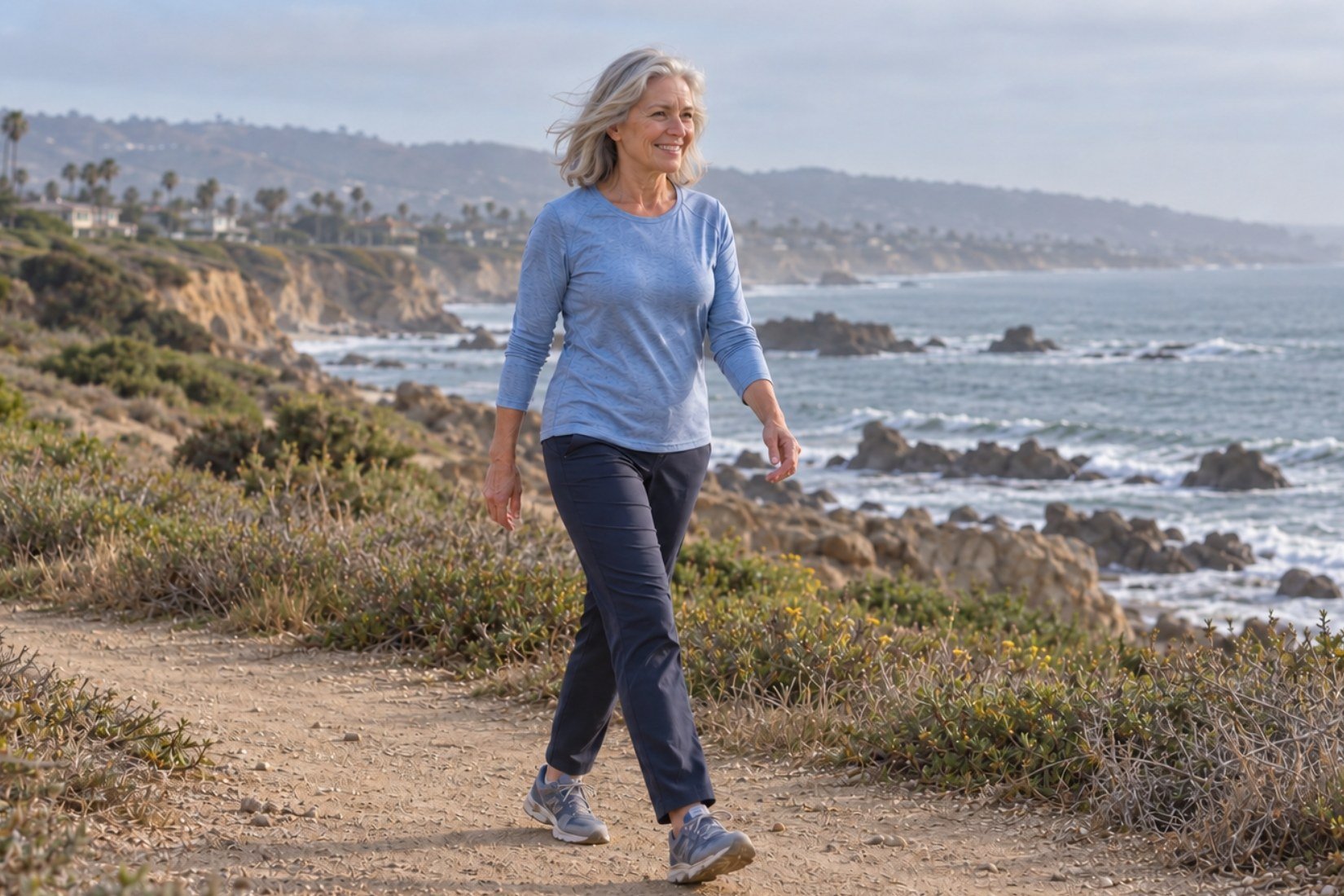
The scan came back with a word on it, osteopenia or osteoporosis, and the advice that came with it was simple: walk more. So you do. Most days, around the neighborhood or along the coast.
And somewhere along the way you start to wonder whether it's doing what you hoped. Is walking enough to protect your bones?
The Short Answer
Walking is good for you, and worth keeping. On its own, though, it usually isn't enough to protect your bones.
Your bones need something walking doesn't give them. The good news is that it can be added, at a level that's right for you.
What Walking Does for You
Walking is weight-bearing exercise: your legs and hips carry your body weight with every step.
It keeps you moving. It's good for your circulation, your mood, and your joints. And it's a habit that's hard to build and easy to lose. None of that is in question.
Why “Walk More” Is Such Common Advice
“Walk more” is easy advice to give and easy to follow. It’s free, it’s low risk, and almost anyone can start tomorrow. For a woman who hasn’t been exercising, it’s a real step forward.
The advice isn’t wrong. It’s just where the conversation usually stops, often because a follow-up appointment doesn’t leave time for more. What walking can’t do for your bones gets left out.
Why Your Bones Need More Than Walking
Bone responds to being loaded. Walking is a load your skeleton already handles every day, so on its own it asks very little new of your bones.
That's why exercise guidelines for osteoporosis recommend adding resistance exercise and, where it's right for you, impact.
None of this means the walking was wasted. It was never the whole picture.
How Your Bones Respond to Exercise
Bone is living tissue. It’s renewing itself all the time, and it adapts to what you ask of it.
What your bones notice is a change: a load that’s a little heavier than usual, or one that comes from a direction they aren’t used to. Once a load becomes routine, it stops being a reason to adapt.
That’s the catch with walking on its own. The first walks after a long break may ask something new of your bones. A few months in, the same walk is something your skeleton handles without a second thought.
It’s also why a program for your bones has to keep progressing. A weight that challenged you when you started becomes your new normal, so the work has to keep getting a little harder, at a pace that’s right for your body.
Our guide Why Walking Isn’t Enough goes further into what “load” means for your bones and what a program built around your scan looks like.
What Your Bones Respond To
Resistance
When your muscles work against resistance, they pull on the bones they're attached to. On the Reformer, the springs are that resistance, which is part of why therapeutic Pilates supports bone density. We've written about what the Reformer's springs change if you'd like to know more.
Strength training with weights does the same job. Our post on strength training for women over 40 goes into it in more depth.
Impact, at the Right Level for You
How much impact is right for you depends on what your scan shows and how your body moves. It's something to work up to with someone watching, not something to start on your own.
Strength and Balance
Strength, balance, and how quickly you react don't show up on a DEXA scan, and all three can be trained. They're what let you carry your own groceries, step off a curb without a second thought and spend a morning in the garden.
Walking does a little for your balance, especially on uneven ground. But most walks are on flat, predictable surfaces, which is the easiest kind of balance there is.
Balance and reaction time are trained by practicing the harder version on purpose: shifting your weight, turning, stepping in different directions, and catching yourself.
Strength matters just as much. Strong legs and hips are what get you up from a low chair, up a flight of stairs and out of the car without pushing off the door.
So Should You Keep Walking?
Keep walking. It's the base the rest is built on. What changes is what you add to it.
"I've always been a walker. Three or four miles almost every morning, rain or shine. … Then my DEXA scan showed I had osteopenia, and it really caught me off guard. … I'm carrying heavier groceries, feeling steadier on my feet, and getting up and down from the floor without struggling. … I still love my morning walks, but now I understand that walking alone wasn't giving my body everything it needed."
Patricia, 63 — Osteopenia & Bone Health
Why It’s Worth Having Someone Watch
After a scan, it’s natural to want to get started on your own. A video or an app can show you exercises. What it can’t do is see how you move while you do them.
That matters more when your bone density is low. A few movements are worth approaching differently, and how you set up for an exercise can change what it asks of your spine.
It matters for confidence, too. It’s natural to hold back after a scan when you aren’t sure what’s safe. Working with someone watching is how you find out what your body can actually do.
From Dr. Dawn: When a woman comes to me after a bone density scan and tells me her doctor said to walk more, I tell her, “Walking is great for your overall health, but walking alone isn’t enough to build the strength your bones need as you age.” Especially after menopause, we need to challenge our bones with progressive resistance training, weight-bearing exercise, and movements that improve balance. My goal isn’t just to help women maintain their bone density—it’s to help them stay strong, confident, and independent for decades to come.
Where to Start
What's right for you depends on your numbers, your history, and how you move today. That's something to work out with a specialist watching, not from a list.
That's how physical therapy for osteoporosis works at Revive: we start from what your evaluation finds and build from there.
What Your First Visit Looks Like
At your Discovery Visit, we go through your DEXA results with you. Then we look at what the scan can't show: how you move, how strong you are, and how steady you are. The Revive Movement Screen™ covers all three. You leave with a written plan for what to add to your walking, and in what order.
Questions You Might Have
Does Walking Count as Weight-Bearing Exercise?
Yes. Whenever you're on your feet, your bones carry your body weight, and walking counts. But weight-bearing isn't the same as enough load. Your skeleton is already used to walking, so it isn't a new signal for your bones.
Should I Walk Faster or Farther Instead?
Walking more is good for you, but it's still the same kind of load. What your bones respond to is a load they aren't used to, which is why resistance comes first.
Can Walking Reverse Osteoporosis?
Walking on its own isn’t enough to change what your scan shows. What helps protect your bones is load they aren’t used to, along with the medication, nutrition, and follow-up your doctor recommends for you. Walking is a good base for all of that, not a replacement for it.
Should I Wear Ankle Weights or a Weighted Vest When I Walk?
Check before you add either. Ankle weights change how your hips and knees move with every step, and a weighted vest adds load to your spine. Whether either one is right for you depends on your scan, your posture, and how you move, which is what an evaluation looks at.
Is Walking on a Treadmill as Good as Walking Outside?
For your bones, the two are much the same. Walking outside on varied ground gives your balance a little more to do, and a treadmill is a safe option when the weather or the sidewalks aren’t. The best walk is the one you’ll keep doing.
If you've just had a bone scan and been told to walk more, our guide Why Walking Isn't Enough explains what "load" actually means for your bones, why walking doesn't provide enough of it, and what a program built for your body looks like.
If you live in or near North County San Diego, start with a Discovery Visit: one 60-minute session with a women's health specialist at our Encinitas studio, and you walk out with a plan built for the body you have now.
No referral needed. No pressure — just answers and a plan.
Source: Brooke-Wavell K et al., "Strong, steady and straight: UK consensus statement on physical activity and exercise for osteoporosis"