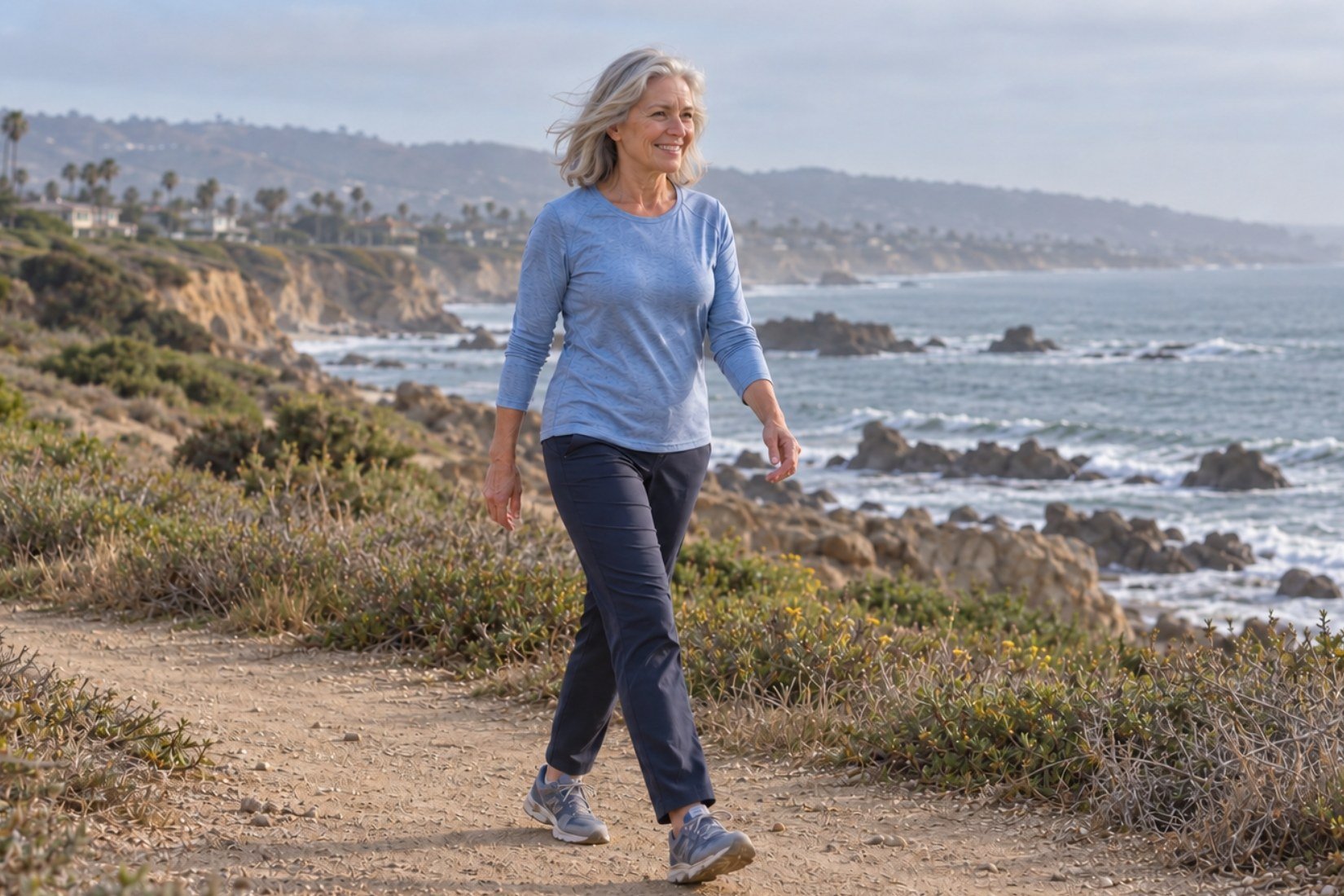
The scan came back with a word on it, osteopenia or osteoporosis, and the advice that came with it was simple: walk more. So you do. Most days, around the neighborhood or along the coast.
And somewhere along the way you start to wonder whether it's doing what you hoped. Is walking enough to protect your bones?
The Short Answer
Walking is good for you, and worth keeping. On its own, though, it usually isn't enough to protect your bones.
Your bones need something walking doesn't give them. The good news is that it can be added, at a level that's right for you.
What Walking Does for You
Walking is weight-bearing exercise: your legs and hips carry your body weight with every step.
It keeps you moving. It's good for your circulation, your mood, and your joints. And it's a habit that's hard to build and easy to lose. None of that is in question.
Why Your Bones Need More Than Walking
Bone responds to being loaded. Walking is a load your skeleton already handles every day, so on its own it asks very little new of your bones.
That's why exercise guidelines for osteoporosis recommend adding resistance exercise and, where it's right for you, impact.
None of this means the walking was wasted. It was never the whole picture.
What Your Bones Respond To
Resistance
When your muscles work against resistance, they pull on the bones they're attached to. On the Reformer, the springs are that resistance, which is part of why therapeutic Pilates supports bone density. We've written about what the Reformer's springs change if you'd like to know more.
Strength training with weights does the same job. Our post on strength training for women over 40 goes into it in more depth.
Impact, at the Right Level for You
How much impact is right for you depends on what your scan shows and how your body moves. It's something to work up to with someone watching, not something to start on your own.
Strength and Balance
Strength, balance, and how quickly you react don't show up on a DEXA scan, and all three can be trained. They're what let you carry your own groceries, step off a curb without a second thought, and spend a morning in the garden.
So Should You Keep Walking?
Keep walking. It's the base the rest is built on. What changes is what you add to it.
"I've always been a walker. Three or four miles almost every morning, rain or shine. … Then my DEXA scan showed I had osteopenia, and it really caught me off guard. … I'm carrying heavier groceries, feeling steadier on my feet, and getting up and down from the floor without struggling. … I still love my morning walks, but now I understand that walking alone wasn't giving my body everything it needed."
Patricia, 63 — Osteopenia & Bone Health
Where to Start
What's right for you depends on your numbers, your history, and how you move today. That's something to work out with a specialist watching, not from a list.
That's how physical therapy for osteoporosis works at Revive: we start from what your evaluation finds and build from there.
What Your First Visit Looks Like
At your Discovery Visit, we go through your DEXA results with you. Then we look at what the scan can't show: how you move, how strong you are, and how steady you are. The Revive Movement Screen™ covers all three. You leave with a written plan for what to add to your walking, and in what order.
Questions You Might Have
Does Walking Count as Weight-Bearing Exercise?
Yes. Whenever you're on your feet, your bones carry your body weight, and walking counts. But weight-bearing isn't the same as enough load. Your skeleton is already used to walking, so it isn't a new signal for your bones.
Should I Walk Faster or Farther Instead?
Walking more is good for you, but it's still the same kind of load. What your bones respond to is a load they aren't used to, which is why resistance comes first.
If you've just had a bone scan and been told to walk more, our guide Why Walking Isn't Enough explains what "load" actually means for your bones, why walking doesn't provide enough of it, and what a program built for your body looks like.
If you live in or near North County San Diego, start with a Discovery Visit: one 60-minute session with a women's health specialist at our Encinitas studio, and you walk out with a plan built for the body you have now.
No referral needed. No pressure — just answers and a plan.
Source: Brooke-Wavell K et al., "Strong, steady and straight: UK consensus statement on physical activity and exercise for osteoporosis"