Are you tired of mapping out bathrooms everywhere you go?
You sneezed in the grocery store aisle and immediately crossed your legs, praying it wasn't too late. You stopped doing jumping jacks. You gave up on the trampoline park with your kids. You skip the high-intensity workout classes because you're terrified of a leak. You were handed a generic sheet of Kegel exercises and told your symptoms are just "normal for your age."
Let’s get one thing straight right now: Bladder leaks, pelvic pressure, and prolapse are NOT just what getting older feels like.
If you have been hoping a Pilates class would be the magic bullet that strengthens your core and fixes your pelvic floor, you are likely setting yourself up for disappointment—or worse, injury.
Why? Because most Pilates is just fitness. And when you are dealing with real, structural changes in your body—like urinary incontinence, pelvic organ prolapse, or the physical shifts of perimenopause and menopause—a generic fitness class can make your symptoms worse.
The Problem With Generic Pilates for Pelvic Floor Issues
Most women have been told to just "strengthen your core" or "do more Kegels." Then they end up in a crowded room with a generic sequence that was never designed around the biomechanics of a woman's body over 40.
If you are dealing with pelvic floor dysfunction, doing a standard "hundred" or an aggressive double-leg lower in a generic Pilates class can actually increase intra-abdominal pressure. What does that mean? It means you are pushing down on a pelvic floor that is already struggling to support you. You are literally pushing your organs downward.
In fact, doing the wrong kind of Pilates can exacerbate pelvic organ prolapse and increase urinary incontinence.
You don't need a fitness class. You don't need a generic routine. You need a solution. You need someone who actually understands the female body.
What Happens If You Keep Settling?
Think about where you are right now. You have started planning your day around what your body can and cannot handle. You calculate the distance between your car and the nearest restroom. You hesitate before picking up heavy groceries. You look in the mirror and wonder where the strong, confident woman you used to be went.
She is not gone. She is waiting.
But if you keep settling for half-answers... if you keep going to generic fitness classes that aren't built for your specific needs... if you keep accepting that leaks and pain are just "part of aging"... your world is only going to get smaller.
Every time you modify your life around your pelvic floor, you are giving up a piece of your freedom. The hikes you don't take. The laughs you stifle. The moments you miss because you are distracted by fear.
You deserve to move through the world without fear of your own body. You deserve to laugh freely, sneeze without bracing, and take the road trip. That is what the other side looks like.
Therapeutic Pelvic Floor Pilates
This is where the game changes. At Revive PT & Pilates in Encinitas, we do not do generic fitness. We do Therapeutic Pilates.
What is the difference, and why does it matter for your pelvic floor?
Every Pilates specialist on our team is personally trained by Dr. Dawn Andalon, DPT, in her Pelvic & Core Reset™ Method. And we are the only practice in North County San Diego that combines physical therapy and Therapeutic Pilates, where every client is a woman over 40.
When you do Therapeutic Pilates with us, it is a completely different experience:
1. It Is Designed for Your Exact Body
Generic Pilates assumes every body in the room is the same. Therapeutic Pilates knows they are not. Our method is specifically safe for pelvic floor recovery, post-surgical rehabilitation, osteoporosis, and bone density. We know exactly which movements to avoid if you have prolapse, and which movements help support your pelvic organs instead.
2. We Target the Root Cause, Not Just the Symptoms
We don't just manage symptoms. We find out what is actually driving your dysfunction and work on that. Often, pelvic floor issues aren't just about a "weak" pelvic floor. Sometimes the muscles are too tight (hypertonic) and need to learn how to relax before they can strengthen. Sometimes the issue is actually in your hips or your breathing patterns. We look at the whole picture.
3. It Is Intimate and Expert-Led
We offer private and small group reformer Pilates. This means you are always supported, always safe, and never lost in a crowd. You are never left wondering if you are doing an exercise correctly, because an expert trained in women's health is watching your form the entire time.
4. The Integration of Breath and Movement
True pelvic floor Pilates is heavily reliant on the diaphragm. Your diaphragm and your pelvic floor work together like a piston. If you are holding your breath during exercise (which most people do in difficult fitness classes), you are bearing down on your pelvic floor. We teach you how to coordinate your breath with movement to naturally engage and lift the pelvic floor.
Why Kegels Are Failing You
Let's address the elephant in the room: Kegels. Every time a woman complains about bladder leaks, she is told to "do her Kegels."
Here is the truth: Kegels aren't the whole answer, and for some women, they are the wrong one. If your pelvic floor muscles are tight and spasming, doing more Kegels is like doing bicep curls with a muscle that is already cramped. That's why we check what your pelvic floor is actually doing before we give you anything to do.
Therapeutic Pilates goes far beyond the Kegel. It integrates the pelvic floor with the deep core (the transversus abdominis), the multifidus muscles in your back, and your diaphragm. It trains your body to function as a cohesive, supportive unit, rather than just isolating one small muscle group.
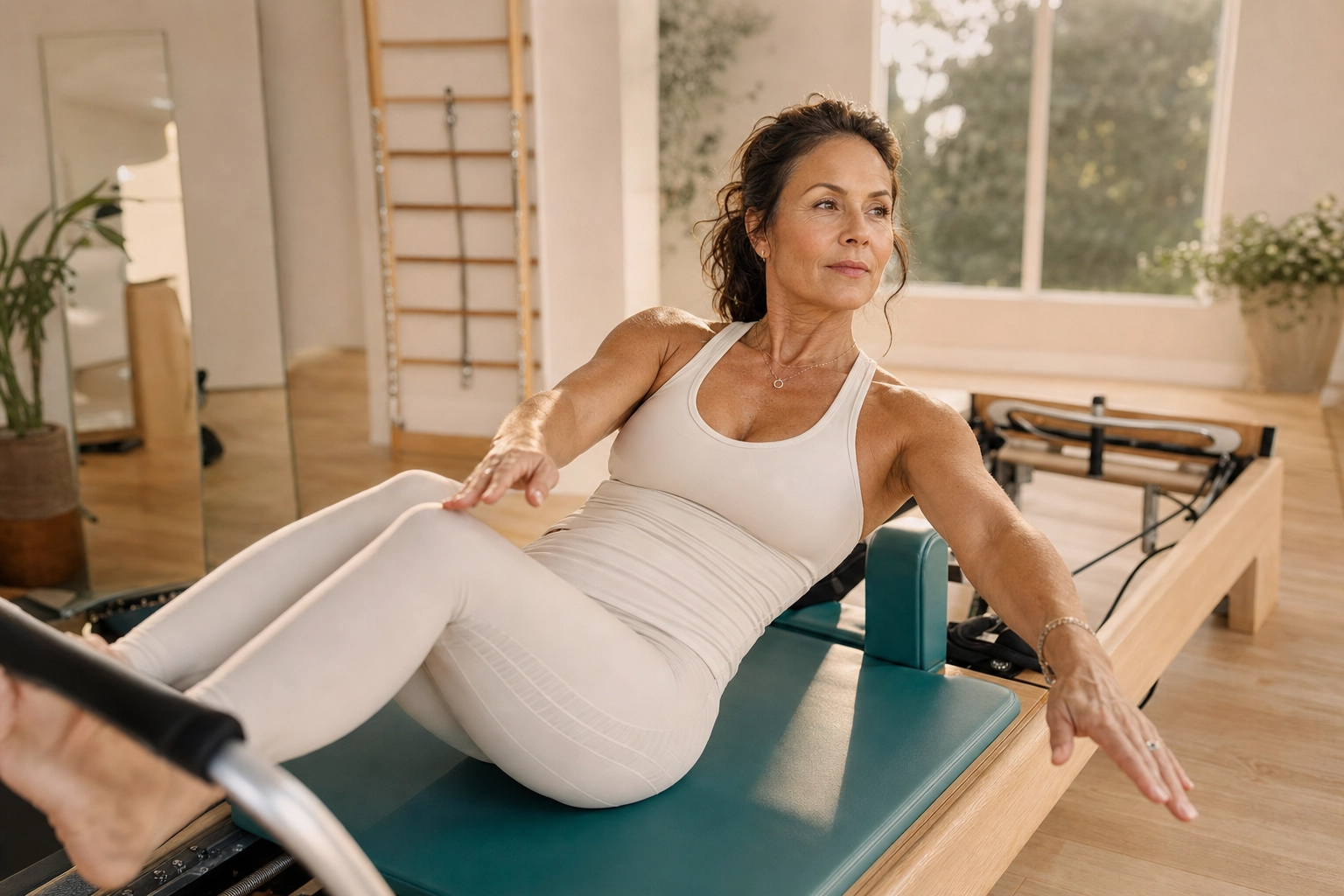
Why the Reformer Helps Your Pelvic Floor
When you strengthen the deep core stabilizers in a controlled, low-impact environment like the Pilates reformer, you provide a stable base for your pelvis. This stability is crucial for women navigating the hormonal changes of perimenopause and menopause, which can naturally weaken the connective tissues supporting the pelvic organs.
Who Is Therapeutic Pilates For?
If you relate to any of the following, Therapeutic Pilates is built for you:
You experience stress incontinence: Leaking when you cough, laugh, sneeze, or jump.
You have pelvic organ prolapse: A feeling of heaviness or pressure in your pelvis.
You are recovering from a hysterectomy or pelvic surgery: And you need a safe way to rebuild your core strength while you heal.
You have back pain or sciatica: Often, chronic back pain is deeply tied to pelvic floor dysfunction and core instability.
You are navigating menopause: And want to proactively protect your pelvic health and bone density.
You are simply done with fitness programs that weren't built for your body: You want to move well for the rest of your life.
What to Expect at Revive PT & Pilates
When you walk through our doors in Encinitas, you are not walking into a loud, intimidating gym. You are walking into a sanctuary built specifically for women over 40.
We understand that talking about pelvic floor issues can feel vulnerable. Our team of specialists is compassionate, highly trained, and deeply committed to your success. We have helped more than 4,700 women across North County San Diego since 2016.
Here is what the journey looks like:
Step 1: The Assessment
We don't guess; we assess. Before you ever get on a reformer, we want to know your story. What have you been experiencing? How long has it been going on? What do you want your life to look like? In your first session, we take you through the Revive Movement Screen™, a movement and posture assessment, so the program we build fits your body.
Step 2: The Custom Program
Based on your assessment, we build a program designed specifically for your body using the Pelvic & Core Reset™ Method. Your plan may include hands-on manual therapy, pelvic floor rehabilitation, targeted core work, and therapeutic Pilates.
Step 3: Getting Your Life Back
Session by session, your body gets stronger, more stable, and more capable. You start noticing things you couldn't do before. A longer walk. A better night's sleep. Less pain. More confidence. These aren't side effects. They are the point.
Your Next Step: Do Not Settle. Take Action Today.
You have a choice. You can keep trying generic classes, hoping for a different result while your world gets smaller. Or you can finally get the expert, one-on-one care your body desperately needs.
If you'd like somewhere to start at home, our guide The 5-Minute Pelvic Floor Routine walks you through three short steps that reconnect your breath, deep core and pelvic floor, and explains the signs that mean it's time to be seen.
If leaking, pressure or prolapse is why you're reading this, start with a Discovery Visit: one 60-minute session with a women's health specialist at our Encinitas studio, and you walk out with a plan built for the body you have now.
If you have no symptoms and simply want Pilates built around your pelvic floor, start with a Pilates Intro Session instead, where we take you through the Revive Movement Screen™ and show you how Pilates can be adapted for your body.
No referral needed. No pressure — just answers and a plan.