
You've been doing your pelvic floor exercises. Most days, from a video or an app. And you're still not sure they're doing anything.
There's a question most of those exercises never ask: What is your breath doing while you do them?
The Short Answer
Your pelvic floor is built to move with your breath, not to work on its own. An exercise that skips the breath is only training part of the system.
How Your Diaphragm and Pelvic Floor Move Together
Your diaphragm is the dome-shaped muscle under your ribs. Your pelvic floor is the layer of muscle at the base of your pelvis. Your diaphragm and your pelvic floor are the top and bottom of the same pressure system.
As you breathe in, your diaphragm lowers, and your pelvic floor eases down with it. As you breathe out, your pelvic floor lifts gently back up.
Breathing low and wide, into your belly and your side ribs rather than high in your chest, is what diaphragmatic breathing means.
Your Core Works Like a Canister
It helps to picture your core as a canister. Your diaphragm is the lid. Your pelvic floor is the base. Your deep abdominal muscles wrap around the front and sides, and the deep muscles of your back close it in behind.
Every time you breathe, lift, cough, or stand up, the pressure inside that canister changes. When all four sides share the work, your pelvic floor only has to manage its part. When one of them isn't doing its share, more of that pressure ends up pressing down.
Research has recorded the pelvic floor muscles switching on during breathing as well as during movement, with most of that breathing-related activity happening on the out-breath.
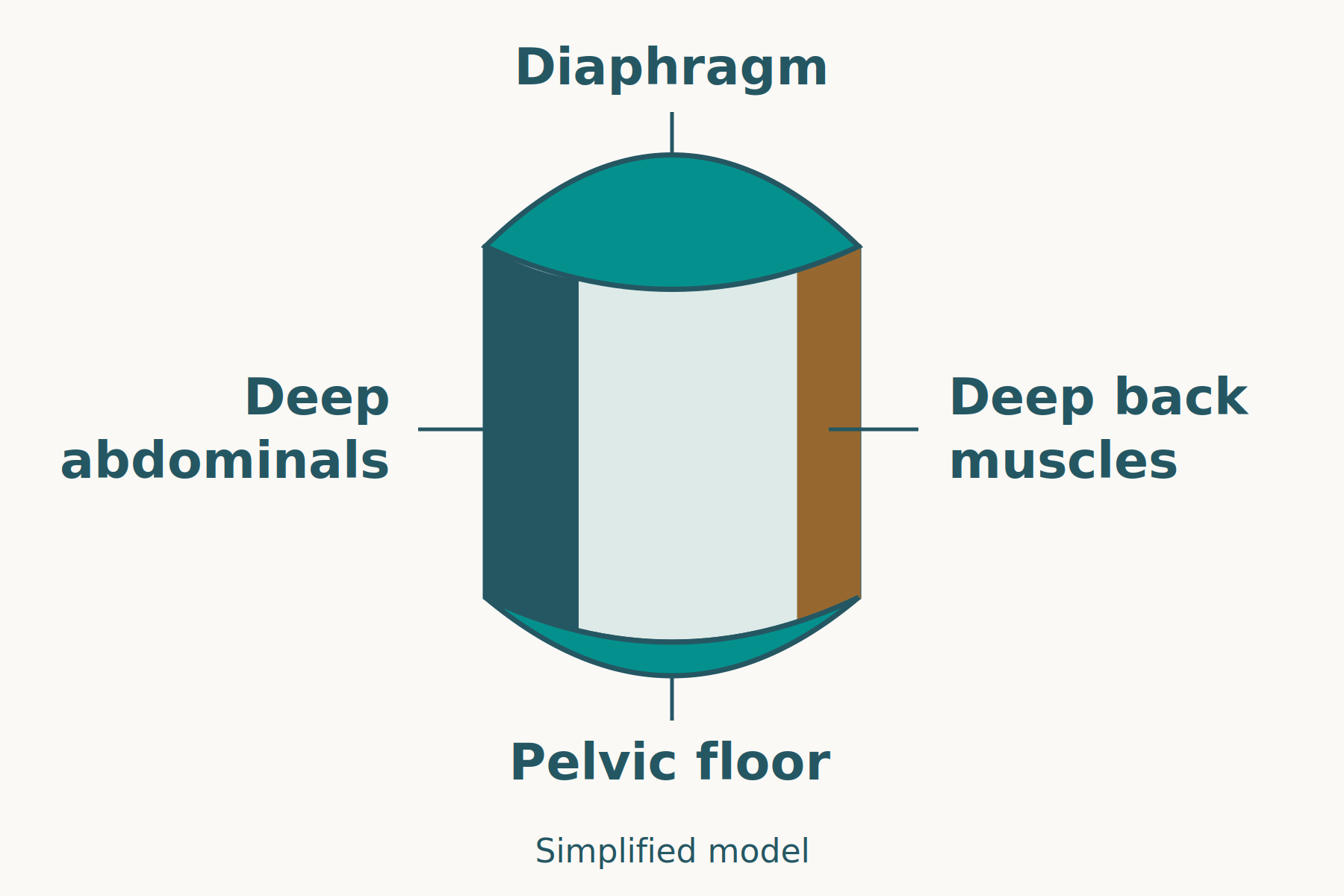
Your diaphragm and your pelvic floor are the top and bottom of the same pressure system.
What Happens When You Hold Your Breath
Many women hold their breath or breathe shallowly without noticing, and that adds pressure your pelvic floor has to meet.
Holding your breath or bearing down while you lift, push, or strain is one of the most common ways that pressure builds. It can happen without you noticing: reaching into the back seat, getting up from a low chair, carrying the groceries in from the car.
"I've always considered myself pretty active. … But I started noticing this uncomfortable heaviness in my pelvic area, especially after exercising or spending a long day on my feet. … During one of my sessions at Revive, my therapist noticed that I was holding my breath whenever an exercise got difficult. … What surprised me was how much more comfortable certain exercises felt once I stopped bracing and holding my breath through everything. … And that heavy feeling that used to bother me after exercise? It's become much less of an issue."
Elaine, 58 — Pelvic Pressure & Core Strength
H3 — Why Breathing Habits Change
Breathing patterns drift over the years without anyone noticing. Long hours sitting, rounding over a desk or a phone, and stress can all move your breath up into your chest. So can a habit that's easy to pick up and hard to notice: holding your stomach in.
Breathing high in your chest isn't harmful in itself. But when the breath stays high, your diaphragm moves less, and your pelvic floor loses some of the rhythm it's built to follow.
Why a Squeeze on Its Own Misses It
A squeeze asks one group of muscles to do a job that's meant to be shared with your breath and your deep core.
Your deep core is the muscle that wraps around your middle like a corset. It and your pelvic floor are meant to switch on together, in time with your breath. It's also why Pilates starts with the breath; we've written about Pilates exercises for your pelvic floor.
Breathing When You Move
The same pairing carries into movement. In Pilates, and in most of the work we do at Revive, you breathe out on the effort: as you push, lift or straighten.
Breathing out on the effort lets your pelvic floor lift and your deep core switch on at the moment the load arrives. Holding your breath does the opposite, and the pressure has nowhere to go but down.
It takes practice. At first, it's common to hold your breath at exactly the hardest moment. That's the habit the practice is replacing.
Signs Your Breathing Is Part of It
A few signs your breath may be part of what's going on:
You hold your breath when an exercise gets hard, or when you lift something heavy.
Your lift feels like a hard clench rather than a light draw upward.
You can't feel your pelvic floor lift at all, or you aren't sure you're doing it.
You bear down, or clench everything at once, when you try.
A lift that feels like a hard clench, or one you can't feel at all, is a sign it's worth having someone check.
Where to Start
Start by noticing. The next time you lift, push, or get up from a chair, check whether you're holding your breath.
Step 1 of our guide is a breathing exercise that trains your breath and your pelvic floor to move together. Breathing on its own won't fix leaking or pressure, but without it, the rest of the work is missing a piece.
The full exercise is in our guide, The 5-Minute Pelvic Floor Routine.
From Dr. Dawn: Some of the most common things I see women do:
Pushing down instead of managing pressure.
Belly doming (letting your belly push outward) instead of controlling the abdominal wall.
Holding their breath instead of coordinating their exhale.
Gripping their abs instead of allowing their core to respond naturally.
Constantly squeezing their pelvic floor instead of learning to contract and fully relax.
If you're still leaking or feeling heaviness after a few weeks of doing the routine consistently, or any step causes pain, that's a sign to be seen. That's what [pelvic floor physical therapy] (link: /pelvic-floor-physical-therapy) at Revive is for: we look at how your breath, deep core and pelvic floor are working together, and build from there.
What Your First Visit Looks Like
At your Discovery Visit, a women's health specialist takes you through a complete clinical evaluation: the Revive Movement Screen™, a pelvic floor screen if needed, and a postural analysis. Your plan is built in the room, and you leave with a written action plan.
Questions You Might Have
Is Diaphragmatic Breathing the Same as Belly Breathing?
Close, but not quite. Belly breathing usually means letting your belly rise as you breathe in. Diaphragmatic breathing lets your belly, your side ribs, and your pelvic floor all soften and expand as you breathe in.
Can Breathing Really Make a Difference to Leaking or Pressure?
It's one part of the picture. Your breath, deep core, and pelvic floor work as one system, so if your breathing adds pressure, the rest of that system has more to manage. What changing it can do for you depends on what's going on, which is what an evaluation finds out.
Should I Breathe In or Out When I Lift My Pelvic Floor?
Out. As you breathe out, your pelvic floor lifts gently back up, so the out-breath is the natural time to add a light lift. Trying to lift as you breathe in works against the way the two are built to move.
Does Holding My Stomach In Help My Core?
Not in the way it feels like it should. Holding your stomach in all day keeps your breath high in your chest and adds pressure that has to go somewhere, often down toward your pelvic floor. Your deep core works best when it switches on with your breath, not when it's held tight all the time.
Is It Normal Not to Feel My Pelvic Floor at First?
Yes, it's common, especially if you've never been shown what to feel for. If you still can't feel a lift after you've been practicing, that's one of the signs it's worth having someone check.
If you've been doing pelvic floor exercises and aren't sure they're working, our guide The 5-Minute Pelvic Floor Routine walks you through three short steps that reconnect your breath, deep core, and pelvic floor, and explains the signs that mean it's time to be seen.
If you live in or near North County San Diego, start with a Discovery Visit: one 60-minute session with a women's health specialist at our Encinitas studio, and you walk out with a plan built for the body you have now.
No referral needed. No pressure — just answers and a plan.
Source: Hodges PW et al., "Postural and respiratory functions of the pelvic floor muscles", Neurourology and Urodynamics, 2007.