Why Modifying Your Ab Workout With Diastasis Recti Is Not The Answer
Diastasis Recti
One of the most common things we see in women who have had children is diastasis recti, a separation of the abdominal muscles. It is far more common than most women realize. In one study, every woman measured at 35 weeks of pregnancy had it, and about four in ten still did six months after giving birth. For some women, especially after more than one pregnancy, the separation never fully closes.
Many of the women who come to us with it are in their 40s, and their last baby was not recent. What we hear is some version of: I'm done having kids, and it's time to start working on my body. Then they go back to working out and notice a "tenting" or "doming" down the middle of the stomach whenever they do core work.
What Is Diastasis Recti?
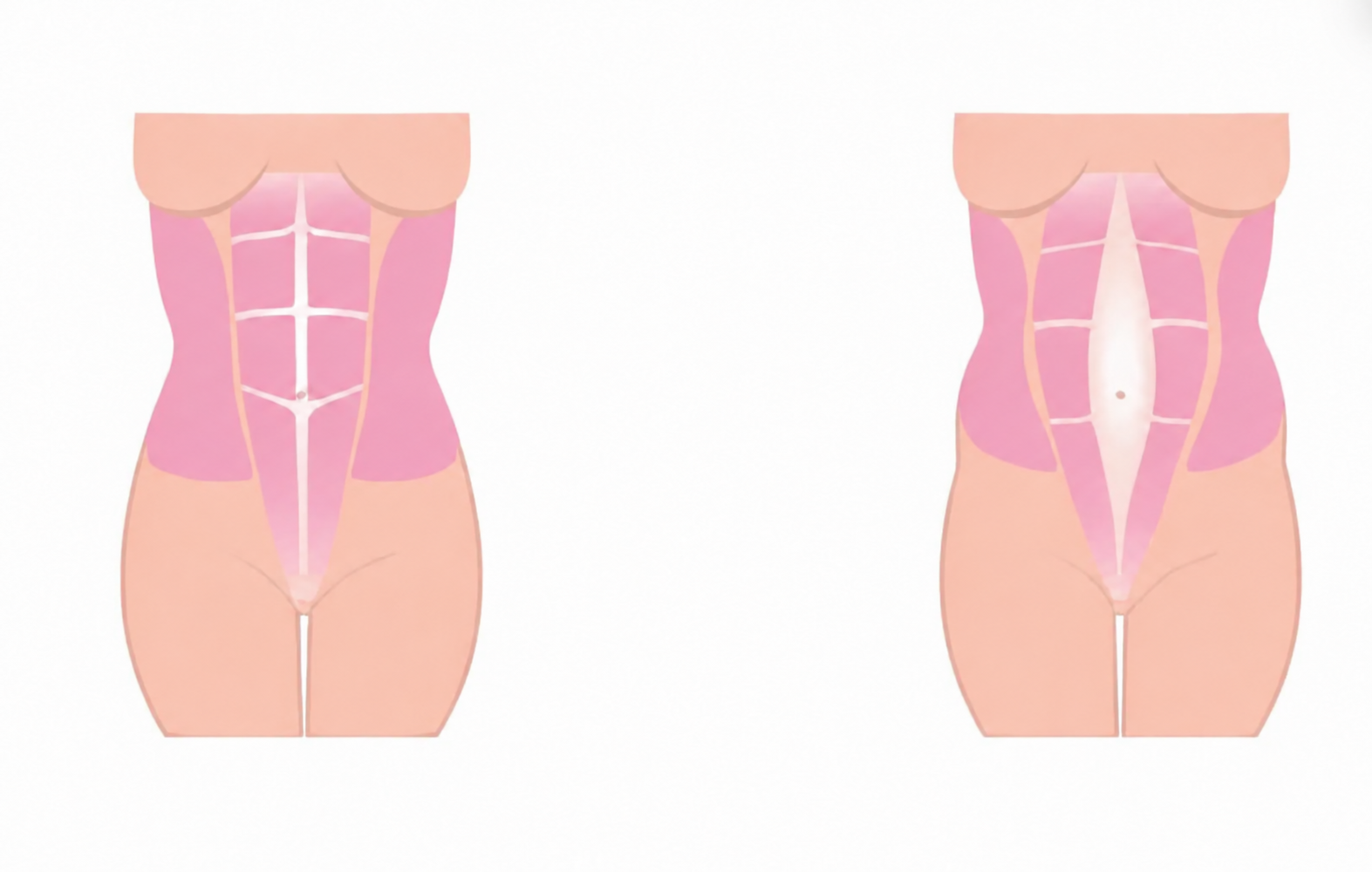
Diastasis recti is a thinning of the linea alba, the band of connective tissue that runs down the middle of the rectus abdominis, your "six-pack" muscles. The thinning is what makes it look like the muscles have separated. It's usually checked by how many fingers fit into the space, and it's important to consider not only the width but the depth.
Check Yourself
This short video walks you through checking for a separation yourself.
Self-assessment video
Why Is Diastasis Recti a Concern?
For many women, the first concern is how it looks. We hear, "Will my abs ever go back to normal?" and "I've lost the baby weight, but I still have a bulge that won't go away."
Many also worry that certain moves will make it worse — sit-ups, planks, twisting, some yoga poses — and stop going to classes because they don't trust their body to do the workout well. Whether a given exercise is a problem depends entirely on the woman, which is why a blanket list of moves to avoid isn't much help.
Diastasis recti also isn't always the only thing going on. In our experience, it often shows up alongside back pain, or alongside leaking when you run, jump or sneeze. They share the same system, and it's worth looking at all of it together.
How Is the Core Connected?
Your abdominal muscles are only one part of your core. Think of the core as a container: your diaphragm, the breathing muscle, at the top; your transverse abdominis, the deepest abdominal layer, wrapping the sides and front; your pelvic floor, a basket of muscles supporting your pelvic organs, at the bottom; and your multifidus, which helps stabilize your spine, at the back. When the front of that container is stretched and weakened, the rest of your trunk and pelvis can't work as one efficient system. That's one reason a cough or sneeze can cause leaking when the whole system isn't working together.
What Do I Need to Do to Fix It?
When a separation is still there long after your last baby, more time alone is unlikely to change it, and the same goes for the leaking and back pain that can come with it. What helps is retraining the connection between your brain and these muscles, called neuromuscular training. For some women, that includes a pelvic floor assessment and hands-on help learning to activate the deepest layer of muscles. It can also mean working on muscles that have become tight or shortened and won't respond to exercise alone. This is the work of pelvic floor physical therapy.
That's why modifying your workouts around diastasis recti will only get you so far. Your core is a system, and it needs to work well to protect you from injury, support your running and the sports you love, and support sexual function.
What to Do Next?
If you live in or near North County San Diego, start with a Discovery Visit: one 60-minute session with a women's health specialist at our Encinitas studio, and you walk out with a plan built for the body you have now.
No referral needed. No pressure — just answers and a plan.
Source: Mota PG et al., "Prevalence and risk factors of diastasis recti abdominis from late pregnancy to 6 months postpartum, and relationship with lumbo-pelvic pain," Manual Therapy, 2015.