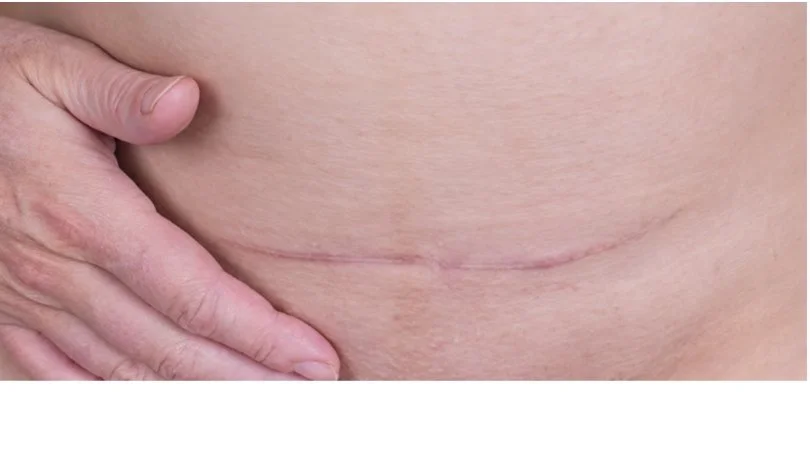
A C-section scar from years ago can still be worth a look.
C-Section Recovery: Scar Care, Core Strength and Exercise, Years Later
Many of the women who come to us in their early 40s put it the same way: they're done having kids, and it's time to start working on their body. For a lot of them, the last baby arrived by C-section — sometimes a year ago, sometimes ten.
You probably got plenty of advice about the first six weeks — don't lift, don't drive, don't exercise. Then came the six- to eight-week checkup, your OB/GYN said your scar was "healed," and for most women that was the end of the conversation.
Very little guidance is given about scar massage, exercise progression, or pelvic floor recovery. But a C-section is major abdominal and pelvic surgery. Healing doesn't stop at six weeks, and if nobody showed you how to rebuild afterward, it's not too late to start now.
At Revive PT & Pilates in Encinitas, we help women over 40 rebuild after a C-section, whether it was last year or a decade ago, so they can return to exercise, strengthen their core and pelvic floor, and feel confident in their bodies again.
How Common Are C-Sections?
C-sections are incredibly common: 32.4% of U.S. births in 2024 were cesarean deliveries, close to one in three. But even though so many women deliver by C-section, the follow-up care is often minimal.
Healing is different for every woman. A review of the research found that about one in ten women still have pain at the scar a year or more after a C-section. If yours still pulls, aches, or feels numb, it's worth having it looked at.
Why C-Section Recovery Needs More Than Rest
If you had surgery on your knee or shoulder, follow-up physical therapy would usually be recommended. But after abdominal surgery like a C-section, women are rarely referred to pelvic floor physical therapy, and that needs to change.
C-section recovery is not just about the incision healing; it involves rebuilding strength, mobility, and confidence. Without guidance, many women push too hard, too soon, or avoid exercise entirely because of fear or pain, and years later, that can still be where things stand.
Signs Your C-Section Recovery Isn't Finished
You may notice:
Pain or sensitivity around the incision site
Numbness or tightness in the abdominal area
Weakness in the core and pelvic floor
Bladder or bowel changes (including incontinence)
Fear of movement or exercise
These are common, but they are not "normal" long-term, even years after your C-section. With the right treatment, many women feel stronger and more connected to their bodies again.
Scar Massage and Scar Mobility
Scar tissue often develops after a C-section and can cause discomfort, pulling sensations, or even long-term adhesions, and that can be true long after the scar looks healed. A pelvic floor physical therapist can teach you scar massage techniques, including:
Gently moving the scar up and down
Circular motions along the incision
Light pressure at different angles to mobilize tissue
These techniques improve blood flow, help the tissue move more freely, and help reconnect you to your abdominal muscles.
Safe Exercise After a C-Section, Even Years Later
Being cleared at six weeks, or having had your C-section years ago, doesn't mean your core and pelvic floor are ready for intense workouts. If you never rebuilt from the inside out, start with gentle, restorative movements such as:
✅ Breathing exercises for core connection
✅ Walking to improve circulation and boost mood
✅ Gentle core restoration guided by a pelvic floor specialist
✅ Bodyweight movements (once cleared and pain-free)
Hold off on these until your core and pelvic floor are ready for them:
❌ Running or jumping
❌ Crunches or leg raises
❌ Heavy lifting
❌ High-impact workouts
The goal is to progress gradually — not push through pain.
Why Work With Revive PT & Pilates?
At Revive PT & Pilates in Encinitas, our team of pelvic floor specialists helps women:
Reduce pain and scar sensitivity
Restore strength and mobility in the core and pelvis
Reconnect with their bodies through guided exercise
Work on leaking, pelvic pressure, and other pelvic floor symptoms
Return to exercise and daily life safely and confidently
Take the First Step
You don't have to work around your C-section recovery on your own. With expert guidance, many women feel stronger, have less pain, and return to the activities they love.
If you never rebuilt your core after your C-section, our guide, The 5-Minute Pelvic Floor Routine, walks you through three short steps that reconnect your breath, deep core, and pelvic floor, and explains the signs that mean it's time to be seen.
If you live in or near North County San Diego, start with a Discovery Visit: one 60-minute session with a women's health specialist at our Encinitas studio, and you'll walk out with a plan built for the body you have now.
No referral needed. No pressure — just answers and a plan.
Sources: Osterman MJK et al., "Births: Final Data for 2024," National Vital Statistics Reports, 2026 · Weibel S et al., "Incidence and severity of chronic pain after caesarean section: A systematic review with meta-analysis," European Journal of Anaesthesiology, 2016.